Showing posts with label 31 Days of Horror. Show all posts

Monday, November 4, 2024

31 Days of Horror Redux: Wrapping up


I did not complete my goal of writing about 31 horror movies in 31 days this October. These things happen, and I won’t beat myself up about it. But, I did promise the 31 Days of Horror Redux, and for failing to deliver, I at least owe an explanation. 


For 16 years, I have kept this site up as a hobby, occasionally with more investment and occasionally with less, depending on how my life is shaking out at any given time. Last Cinema Standing is one of the joys of my life, a feeling I hope is conveyed in my writing and particularly around my year-in-review columns, when I take the opportunity to reflect. But, at the end of the day, it is a hobby, and thus, it sometimes falls down the priority list.


A little insight into my life recently: I am currently in the midst of some personal issues revolving around the end of my marriage. All is well, and all parties will be better off and happier once we get through the darkness of this tunnel. Of course, the only way through it is through it. Unrelated to that, I have picked up some additional work in the sports world on nights and weekends for a daily New York newspaper. 


You may have heard that the local New York baseball teams made quite the run to the World Series this year. As a result, I worked every single day of October with no days off and occasional doubles. I am in no way asking for sympathy and recognize that plenty of people out there balance as much or more simply to be able to survive. I am privileged that I can work both jobs from the comfort of my living room and have the flexibility and time to manage them.


However, with the above mentioned in mind, it was perhaps not the wisest decision to add an additional 20,000-30,000 words of horror writing to my plate, on top of the time it would take to watch the films before writing about them. I should also note I take a fiction writing class once per week, so even when I am not writing here, rest assured I am writing.


I am pleased with the pieces I was able to produce in October and had a tremendous amount of fun. I love horror, and I love sharing thoughts about it with others. It is truly one of the great pleasures of my life, but as we all know, life for most is too rarely about pleasure. Ultimately, I wrote about 15 movies over the course of the first 14 days of the month, then had to tap out. 


Over the final 17 days of the month, I watched an additional 10 horror films that were new to me, as well as some personal favorites just for the fun of it. So, to wrap up the 31 Days of Horror Redux, I wanted to share some brief thoughts on the films I didn’t have a chance to write about in full:


Black Friday, directed by Casey Tebo: An alien-invasion horror comedy set on the other scariest day of the year – the shopping holiday known as Black Friday. It’s a good time, and I’m always happy to see Bruce Campbell in anything. Like a feature-length version of the opening scene of Michael Dougherty’s Krampus with aliens thrown in. This 2021 film also got to Black Friday horror two years before Eli Roth’s Thanksgiving tackled similar territory.


Halloween Kills, directed by David Gordon Green: This won’t be the last movie in the Halloween franchise I discuss here. This is the second film in the most recent trilogy, intended as a sequel trilogy to the original film, making this the third film in a tetralogy, if you prefer. If that all sounds like gibberish, well, it is. I had intended to pair this with Halloween Ends to complete the series. However, Ends was not as readily available, and I found this installment uninspired and disappointing, so I was not inclined to go seeking.


Villains, directed by Robert Olsen and Dan Berk: A fun little thriller that proves Bill Skarsgård was destined for horror royalty even before It and Barbarian. His co-star, Maika Monroe, had already done It Follows by this point, but along with this year’s Longlegs, she is clearly on a path to being one of our great horror performers. Lots of fun twists and turns, and though none of the characters acts like a real person might in these situations, the actors (including Kyra Sedgwick and Jeffrey Donovan) give it their all.


King on Screen, directed by Daphné Baiwir: A documentary about the history of Stephen King film adaptations, this is strictly for King heads only. Baiwir largely spends the right amount of time on the correct selection of films (a lot of Misery and Green Mile, not a whole of In the Tall Grass, for instance). There’s a baffling bookend sequence to this film that does nothing for it, and it’s uncomfortable to watch the almost exclusively white, male filmmakers interviewed praise King for his writing of women and people of color.


Tetsuo: The Iron Man, directed by Shinya Tsukamoto: I have to be honest – I could not make heads or tails of the plot of this. In writing this short paragraph, I read the plot description and couldn’t tell you if that actually describes the movie I watched, at least from a story perspective. On the other hand, as an experience, this is a hell of a time. The imagery is a nightmare pulled straight from David Lynch, and the story of a man cursed to turn to metal feels like an astute commentary on the machinery of capitalism. Excited to share and rewatch this one.


Smile 2, directed by Parker Finn: I saw this in theaters after having seen the first film in theaters and enjoying it. This franchise takes the modern trend of “Trauma Horror” to its logical conclusion, featuring a demon that literally feeds on your trauma. Choosing a Sabrina Carpenter-esque pop star as the vessel for the curse is a fun gambit that opens up the world of the story. In service of maximizing its potential for twists and shocks, the movie doesn’t always play fair with its rules, but that’s not the worst thing. The final sequence is the only way this movie could have ended, and while perhaps predictable, it still works.


Rumours, directed by Guy Maddin: Spoilers, but I will almost certainly be writing more about this film when we get to the year in review, so I’ll have deeper thoughts for you then. For now, suffice it to say that Maddin and co-directors Evan and Galen Johnson have crafted a darkly brilliant satire of the way our world works. They also stuff more mood and atmosphere into every frame of this film than most filmmakers will ever find in their whole careers. A masterwork from one of our movie masters.


Humanist Vampire Seeking Consenting Suicidal Person, directed by Ariane Louis-Seize: Louis-Seize is not messing around here. The title is exactly what this movie is about, but the way it is about it is so fresh and fun and interesting. Like a gender-flipped Twilight for moody Canadians, this film takes its horror seriously and cranks up the teenage(-ish; the vampire is in her 90s) angst to a level that feels honest while still self-reflexively humorous. A neat little gem.


Halloween 4: The Return of Michael Myers, directed by Dwight H. Little: I was a Freddy Krueger kid, which you know if you’ve followed the site over the years. I appreciate the original John Carpenter Halloween, but Michael Myers never really did it for me. Freddy is just more fun. So, I mostly skipped all the Halloween sequels, though I did see the Rob Zombie and aforementioned Gordon Green remakes in theaters. This isn’t great. I might have liked it more if I had seen it when I was younger. It is cool to see the birth of Danielle Harris as one of our great horror performers. That said, it’s better than …


Halloween H20: 20 Years Later, directed by Steve Miner: I get what happened here. By 1998, teen slashers were all the way back in the wake of Scream, I Know What You Did Last Summer, etc., so why not bring back the original? Well, this movie is 86 minutes of: That’s why. It’s actually shocking how little happens in this movie and how wasted all of Jamie Lee Curtis, Josh Hartnett, and Michelle Williams are. We don’t ask for a lot from a Halloween movie, but this movie truly gives you the least amount it thinks it can get away with. Reader, it does not get away with it.


Those were all the new horror watches I got through in October. As a treat, I also rewatched two of my favorite films of all time: David Cronenberg’s The Fly and Rusty Cundieff’s Tales from the Hood. They’re both still great. I also watched my favorite of the Leprechaun franchise: Leprechaun 3. That one is set in Las Vegas. It’s exactly as much kitschy fun as that sounds and features most of my favorite kills in the series. Finally, I headed over to the Hollywood Forever Cemetery for an outdoor screening of Trick ‘r Treat, which was a delight, though I do recommend bringing your own snacks ($15 for a cupcake!).


So, that wraps up the 31 Days of Horror Redux. Thanks for bearing with me, and I promise this won’t be the last time I go way too deep on horror movies. Until next time, happy haunting.

Monday, October 14, 2024

31 Days of Horror Redux: Infested and Sting


Welcome to the 31 Days of Horror Redux, a month-long celebration of genre filmmaking. Last time around, I made the recommendations. This time, I will be watching 31 days of films that are completely new to me. I hope you will join me on this journey of discovery.


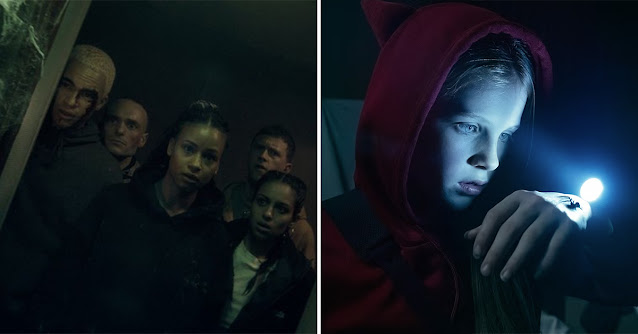
Day 10: Infested, directed by Sébastien Vaniček, and Sting, directed by Kiah Roache-Turner


Spiders. I hate ‘em. Always have. Always will. It’s a primal kind of fear. There is no rationality to it. They’re little bugs like any other little bug, and I don’t mind other little bugs. Don’t particularly want them in my home, but I’m not scared of them. Spiders, on the other hand, pure, paralyzing fear.


With that context, I will tell you a movie I enjoyed very much as a child and have gained a greater appreciation for as an adult is Frank Marshall’s Arachnophobia. So terrifying yet enthralling to me as a child that I even had a little routine for watching it: sit on the floor, pile up blankets all around as a protective wall and stuff them under the couch so there would be no place for spiders to hide, then keep on high alert. It felt equal parts dangerous and fun, which is why I think horror movies appeal to kids. Older now, I appreciate Marshall’s film as a campy throwback to the creepy fun of ‘50s B movies.


That brings us to this double feature of spider movies, both released this year. The French film Infested was released to Shudder, while Sting, an Australian-American production, was in theaters back in the spring. Both are emblematic of the best parts of a creature feature but also have some of the same problems that often plague these kinds of movies. Let’s start with the bad because I really liked both of these movies and want to spend more time talking about their positive qualities.


What makes a spider (or spiders – Infested is, predictably, about an infestation, while Sting is about a single spider) inherently scary? To my mind, they are small and fast, they can hide anywhere, obviously there is potential danger of their bite, and there is something unearthly about a creature with that many legs and eyes that moves the way they do.


Editor’s note: I’m actually freaking myself out a little bit right now just in typing this piece. There’s a small spider on my bookshelf that I keep around for mosquitoes – see, I do recognize their value – and I’m checking on him a little more often as I write these words.


Both films understand all of these aspects and make great use of them. The problem is that Screenwriting 101 says that to hold an audience’s interest, you must continually raise the stakes or increase the threat. Unfortunately, the filmmakers in both of these cases accomplish this by making the spiders bigger. That’s a mistake.


Yes, it’s gross to see a spider the size of a dog or a bear, but it’s not that scary. Their greatest advantage is that they are tiny and could be anywhere, and our homes are filled with little places for them to be. Both films wring tremendous amounts of tension out of this basic idea, but eventually, both lean into: The spiders are getting bigger! The bigger they get, the less scary the movies. None of this is to say that if a spider the size of a car were in my home right now I wouldn’t just have a heart attack and drop dead, but on film, it’s a little silly.


Okay, that’s my complaint. Now for the good stuff, which we’ll talk about individually since each film takes a unique approach to the same basic premise: a deadly spider ends up in an apartment building.


Infested is the superior film in that it is both scarier and thematically richer. Vaniček, who has already been tapped by Sam Raimi and Co. to handle the next installment of the Evil Dead franchise, is even able to smuggle some fairly potent political and cultural themes into his fright flick. There are sequences in this movie I literally watched through my fingers, and I even paused it once to give my poor heart a break.


The film follows Kaleb (Théo Christine), his sister, and their friends as they try to survive their tower block, clearly in a lower-income area of the city, being overrun with deadly spiders. Kaleb is a lover of exotic creatures and keeps various bugs and reptiles in his room. He buys a spider on the black market, brings it home, and all hell breaks loose. The opening of the film is a nice little homage to Arachnophobia


Where the earlier film opens with scientists collecting specimens in a South American jungle, this film opens with smugglers in a Middle Eastern desert, a more culturally relevant reference point in France. Here, it works as a nice little metaphor for the opium trade and the way international drug rings disproportionately affect neighborhoods of color in the cities. If it seems I am reading too much into it, trust that film goes deeper into this metaphor than I am now.


Anyway, the spider gets loose and hides in a pair of shoes that Kaleb sells to a neighbor, and this is what I mean with the tension of a little spider that can hide anywhere. We know it’s in the shoe. It must be in the shoe. The terror is in wondering how the character will learn it is in the shoe. I won’t spoil it here, but it is creepy, surprising, and effective.


When that character’s body is found, the police are called. There is talk of a drug overdose, an infectious disease, maybe, and generally a lot of conspiratorial speculation. Eventually, the building is quarantined and the residents are forcibly kept inside, despite the deadly threat within. There’s a lot of good political allegory in this around the handling of the pandemic and the use of the police to violently suppress and oppress neighborhoods of color and poorer communities.


For the final 20 minutes or so, the spiders take a backseat to the police as the primary threat, and this is right around the time the spiders start to get really big – they reproduce quickly and each successive generation quadruples in size when it feels threatened. So, the end is not quite as strong as the beginning and middle passages, but as a whole, it all works. Frankly, any movie so terrifying that I have to pause it out of fear gets an ‘A’ in my book.


Sting does not rise to that level, but it is effective B movie fun that owes plenty to Arachnophobia but is even more indebted to another famous horror film. I will say right now that I saw the trailer for this movie and the marketing materials and had no idea even about the basic premise, so if you want to go in completely blind, stop reading now. Otherwise, we’re going to talk about what went down in some detail.


Alright, everybody ready? It’s an alien. The spider is an alien. It lands in this apartment building as a tiny little meteor that arrives as part of a passing meteor shower. This suggests the possibility of a full-scale invasion, but this movie wisely confines itself to this single apartment building. A young girl finds the spider – the creature, in look and mannerisms, is exactly like a spider – and takes it home as a pet. Then it starts doing a lot of things spiders can’t do, like whistling, opening the jar it’s kept in from the inside, and growing in size every time it eats.


Eventually, it grows big enough that it’s hiding in the building’s ventilation system and sneaking from apartment to apartment, snatching prey. By this point, it’s pretty clear that the whole movie is a fairly faithful homage to the Alien franchise, particularly the first two films. We even get a chest burster sequence, and the way the spider ensnares its victims and saves them for later is exactly the same as it works in the Alien movies.


I don’t have a problem with any of that. It’s cool to set an Alien movie in an apartment building and to make the xenomorph a spider. But, like I said, the bigger it gets – and it gets big pretty quickly – the less scary it is because it takes it out of the realm of the real. It becomes a sci-fi movie, which is fun but not as frightening. The early sequences when the spider is still basically spider sized are the most effective in the movie.


There is a family drama at the center of the film about the girl and her step-father trying to get along that gives the story its emotional backbone, but it honestly probably takes up too much space. Also, the only people of color in this movie are weird caricatures handled poorly, so that’s not great. But overall, it’s a nice little B movie that’s worth the price of admission. Of course, none of this has made me like spiders more.

Sunday, October 13, 2024

31 Days of Horror Redux: The Purge franchise


Welcome to the 31 Days of Horror Redux, a month-long celebration of genre filmmaking. Last time around, I made the recommendations. This time, I will be watching 31 days of films that are completely new to me. I hope you will join me on this journey of discovery.


Day 9: The Purge: Election Year, directed by James DeMonaco, The First Purge, directed by Gerard McMurray, and The Forever Purge, directed by Everardo Gout


What is a metaphor without subtext? I don’t know, but the Purge franchise would have no trouble answering the question in about 15 different ways, all of which would be so clear as to be unmistakable. These films lack subtlety is what I’m saying – and what the films are saying every five minutes or so. So, the question we face becomes: Is that a problem? Unsatisfying as it may be, the answer is: yes and no.


I was late coming to the Purge movies. I missed all of them in theaters and never had the itch to watch them at home. I don’t know anybody who swears by them, and the premise pretty much tells you everything you need to know. But, there are now five films and a TV series in the franchise, so there must be something there. 


I did a little double feature of the first two films in the series (The Purge and The Purge: Anarchy) one cold January night in New York in 2019. The first one is a nice little home-invasion thriller, and the second one leans heavily into action – these films are produced, in part, by Michael Bay. At the time, a third and fourth film in the series had already come out, but I didn’t feel compelled to go beyond where I left them. But, some inexplicable force drew me to the final three films in the franchise, which I finished in a single sitting this week.


If you are somehow unfamiliar with the premise, I would like to welcome you out from under your rock and inform you that the past 11 years have seen many changes. The Purge Universe presupposes a dystopian America, wherein for 12 hours, one night a year, all crime, including murder, is legal. They always say it that way – “All crime, including murder, is legal” – as if the powers that be are trying to goad you into murder specifically. We find out in The First Purge that this is essentially true.


This setup, of course, is rife with metaphorical and allegorical possibilities, mostly concerning class, race, privilege, and mankind’s inherent humanity or lack thereof. The thing is: None of these films operates on a metaphorical or allegorical level. They are all quite literal and become only more literal as the series goes on. Yet, that’s not what I have a problem with in these movies. Our real-life political discourse is deeply unsubtle and nearly as unhinged as the world depicted here. 


In a truly disturbing fun-house mirror way, one of our current candidates for president of the United States even seemed to suggest a Purge wouldn’t be such a bad idea, saying in reference to exaggerated reports of shoplifting (actually, the corporations can’t pay their rent but would rather blame made-up crimes and criminals for store closures): “You know, these are smart, smart people. They’re not so stupid, but they have to be taught. Now, if you had one really violent day … one rough hour, and I mean real rough, the word will get out, and it will end immediately.” That’s the Purge.


I don’t need to tell you which candidate said that, but the point is that no matter how far these movies take their reality, the real world is constantly nipping at their heels, like some gluttonous ouroboros. So, when I tell you the political commentary in these films sits firmly on the surface at all times, perhaps that is not the greatest knock. We live in times that can neither be parodied nor exaggerated. The whole damn world has lost the plot.


Anyway, we’re here to talk about movies. The consensus seems to be that these movies get worse with each subsequent entry, but that was not my experience. I will rank them all at the end of this piece, but for now, I will say that I think The Purge: Election Year is probably the best balance of horror, thrills, and vox populi speechifying.


Election Year concerns an anti-Purge senator (Elizabeth Mitchell) running for president as she and her head of security (Frank Grillo, reprising his character from Anarchy) attempt to survive the night of violence. The senator is running on a platform of, essentially, We’re better than this. Meanwhile, the ruling party, the New Founding Fathers (NFFA), will use every dirty trick in the book to stop her, including murder, which they love.


This movie came out in July 2016 and is about as close to a 1:1 for the Clinton vs. Trump election cycle as you can get without making one of those HBO docudramas. In real life, Clinton lost. In the movie, the senator wins. But, what is truly fascinating – and further evidence of how our times cannot be parodied – is the final line of the film, spoken during a news broadcast following the election of the senator:


“We’re just now hearing reports about a few scattered incidents around the country where NFFA supporters are reacting violently to this defeat. They are burning cars, breaking windows, looting, attacking police officers …”

This was a full four and half years before the Jan. 6 Insurrection. Of course, every one of those things happened when Trump lost to Biden. Those of us still in possession of our sanity are certainly fearful of what a potential loss to Harris might mean – not fearful enough to change our votes, lest the bastards win through fear (that’s called terrorism, by the way), but fearful nonetheless. But, we’ll get to The Forever Purge in a second.


With nowhere to go really after electing an anti-Purge senator whose main campaign promise is to end the Purge, the franchise went with a prequel for its fourth installment. The First Purge is the first film in the franchise not directed by DeMonaco, though he does have sole writing credit on all five installments. McMurray takes over and gives us a look at the first experimental purge, before it was called the Purge, which takes place among the poor, mostly black and Hispanic, communities of Staten Island.


The series makes it pretty clear that the underlying reason for the Purge is to kill off a lot of poor people and people of color as a way of cutting welfare roles. This is one of the series’ most overt heart-in-the-right-place-but-deeply-problematic assertions. The film is very Rich White Liberal coded, in that it is condescending and thinks it’s helping when it actually completely misunderstands the fundamental problems it is exploring. I am mostly blaming DeMonaco here, since he is the primary authorial voice of the franchise, and not the director of color, McMurray.


One nagging question the film does helpfully answer, though, regards the obsession with murder. Throughout the entirety of the first three films, the biggest question I kept asking was: Would people really turn to murder instantly in a lawless world? I would think theft would be the biggest issue, but the Purge Universe posits a world where everyone carries a murderous instinct (see our piece on Cure from earlier in this series). I don’t really agree with that. Neither does The First Purge.


Here, the NFFA is left disappointed by the early returns of the Purge when it turns out, rather than kill each other in the streets, most people are content just to party with their neighbors. This feels right. So, the government sends in mercenaries to boost the kill numbers and justify the continuation of this practice. By the way, Marisa Tomei is in this movie as the Architect, the social scientist who first conceives of the purge night. She is sorely underutilized. The good guys mostly survive, but we know this is the first purge, so the victory is pretty hollow. Those folks are going to have to survive a lot more of these.


Which brings us to The Forever Purge, which does away with any remnants of subtext, turning them into text, written out in big, bold, all-caps letters. This time, the reins are given to Mexican-American filmmaker Gout, though as mentioned, DeMonaco remains the sole credited writer. This largely city-bound series moves to the vast expanses of Texas for this installment, which follows a group of Mexican immigrants and the racist ranchers they work for as they join forces to survive.


Briefly, America goes (further) to hell as radical Purgers decide that 12 hours of lawlessness just aren’t enough to eliminate the undesirables. They need a Forever Purge, read: a license to kill non-white people any time and place they see fit. The only recourse left is to seek sanctuary across the Mexican border, but due to increasing danger, Mexico eventually closes its border. And, this is where my eyes rolled into the back of my head.


The film’s final sequence involves smuggling a pregnant white woman over the border into Mexico so that she might give her child a better life, free from the constant violence and terror of the US. This is what I mean when I say subtext is out the window. Maybe it was watching all three of these in quick succession, but by this point, I was exhausted by the obviousness of every political idea espoused in these films. And, I largely agree with all those ideas. I just like my films presented with more intelligence than an internet message board.


One last thing, and this is not unique to this franchise, but it bears pointing out: The overarching message of the series is meant to be one of anti-violence. This is great. But, in virtually all of these movies, the hero survives by being the fabled “good guy with a gun.” That’s where you can feel the Bay of it all most acutely. For movies that specifically call out the negative influence of the NRA on our political system, it seems wrong that the good guys often win by shooting the bad guys.


My ranking of the Purge movies:


1. The Purge: Election Year (2016)

2. The Purge (2013)

3. The Purge: Anarchy (2014)

4. The First Purge (2018)

5. The Forever Purge (2021)

Saturday, October 12, 2024

31 Days of Horror Redux: Spider Baby


Welcome to the 31 Days of Horror Redux, a month-long celebration of genre filmmaking. Last time around, I made the recommendations. This time, I will be watching 31 days of films that are completely new to me. I hope you will join me on this journey of discovery.


Day 8: Spider Baby, Or the Maddest Story Ever Told, directed by Jack Hill


I like the alternate title to this film a lot. Spider Baby is truer to the actual events of the story, but The Maddest Story Ever Told feels appropriate for the emotional reality of the world. This is a gothic freakout of epic proportions, with every performance turned up to 10 and the darkly comic joy of the filmmakers bursting through every frame.


I didn’t know anything about this movie going into it and had no expectations. I suppose I thought it might resemble something like Robert Wise’s 1963 adaptation of The Haunting or, a step down from that, perhaps one of those Roger Corman-produced, Vincent Price-starring Edgar Allen Poe adaptations like The Raven or The Pit and the Pendulum. And, it is all that, but from the opening moments of the film’s incredible theme song, we recognize it as something else, too.


There is a knowing campiness to everything about this movie. The comparison I kept coming back to while watching the movie was the original The Munsters TV show, which aired from 1964-1966. Hill’s film, which came out in 1967, is clearly in conversation with that aesthetic, up to and including the theme, which plays like a mashup of the The Munsters theme and “The Monster Mash” from 1962.


The reason I like The Maddest Story Ever Told is because the film’s framing device is that we are hearing the tale told by a survivor of the incidents portrayed, Peter (Quinn K. Redeker). Of course, to an outsider, this would absolutely be the maddest thing that ever happened. However, despite the bookends, much of the story is told from the point of view of the eccentric Merrye family, whose dark secrets we come to learn. It’s the same lesson as The Munsters or The Addams Family: If you tell the story from the POV of the weirdos, the strangest things seem normal.


The Merrye (pronounced Mary) family suffer a genetic curse that causes some members of the family to mentally regress as they physically age, like a reverse Benjamin Button. Those afflicted are Liz (Beverly Washburn), Virginia (Jill Banner), and Ralph (Sid Haig). Their minder is Uncle Bruno, played by the legendary Lon Chaney Jr. The first thing that happens in the movie is Liz murders a delivery man while playing a game of spider, wherein she catches an unsuspecting victim in a net, then uses a pair of knives as makeshift fangs to kill the victim. So, we know we’re in for a wild ride.


The actual plot of the film involves some distant relatives arriving to make a claim on the Merrye estate, given the perceived mental incapacity of Liz, Virginia, and Ralph, while Uncle Bruno tries to get his clan to act normal enough for long enough to get these people to leave. That doesn’t happen.


Chaney, who would appear in just four more films after this, is excellent as the put-upon caretaker of these murderous psychopaths – he made a promise to their father to look after them, you see – and it’s a fun bit of horror history to have Chaney and Haig on screen together. Haig was a Hill favorite, appearing in a number of the director’s films, and of course went on to be a recurring player in the Rob Zombie universe of movies in the 2000s and 2010s. So, in a very real way, this film serves as a bridge across roughly 75 years of horror filmmaking.


One last note, in researching this film for this piece, it appears the house where all of the main action is set is located less than a mile from where I am typing this. The famed Smith Estate in Highland Park is a scant 15 minute walk from my own home. Perhaps I will make a little sojourn over there before this month of horror delights comes to a close.

Tuesday, October 8, 2024

31 Days of Horror Redux: Cure


Welcome to the 31 Days of Horror Redux, a month-long celebration of genre filmmaking. Last time around, I made the recommendations. This time, I will be watching 31 days of films that are completely new to me. I hope you will join me on this journey of discovery.


Day 7: Cure, directed by Kiyoshi Kurosawa


Who are you? This is the central question of Cure, and it is repeated over and over to various characters throughout the narrative. Nearly everyone responds with his profession. I am a policeman. I am a detective. I am a doctor. People define themselves by what they do, which begs the further question: Are all of these people murderers?


Kurosawa’s landmark 1997 feature concerns a hypnotist serial killer who murders through the power of suggestion, turning seemingly normal people against their families, coworkers, and countrymen. At one point, a psychologist working with the police tells our lead detective (Koji Yakusho) that a person cannot be forced under hypnosis to do anything he wouldn’t do in his real life. This means that while none of these people would answer the question of ‘Who are you?’ with, ‘I am a murderer,’ in some dark part of their souls, they are.


What makes Cure so disturbing, then, is not that the killer uses some vaguely supernatural psychic power to force good people into committing unspeakably horrific acts, but rather the suggestion that there are no good people. With the right push, everyone is capable of murder. So, what do we call the man who is unafraid to push? Who is he?


That’s the rub. He doesn’t know. At least, he presents himself as an amnesiac. He is nobody from nowhere, which means he could be anybody from anywhere. This blankness, this emptiness is a repeated motif throughout the film. The detective’s wife appears to be suffering from a kind of early-onset dementia – its own kind of amnesia, slowly transforming the woman he loves into nobody from nowhere. The killer speaks of an emptiness within himself, which he says allows him to see what lies within others. A blurred, faceless form recurs throughout the end stages of the film.


The question becomes: If we don’t know the disease, how can we cure it? But, isn’t the killer the disease? No. The killer is a symptom that lets us know there is a disease. The true illness is whatever it is festering in society that would lead a happy husband to kill his loving wife, a good policeman to kill his partner, and a talented doctor to kill a stranger. What in the culture put this bitterness and resentment there inside these people, allowing a monster to exploit them?


This is a brilliant, brutal film, unafraid to dive deep into this question. Perhaps the closest we come to an answer is in the scene when the detective visits the killer (Masato Hagiwara) in the makeshift hospital prison where he is being held. When Yakusho first enters the room, Kurosawa frames it in such a way as to make the room look empty. The detective then starts talking, and it appears as if he is speaking directly to a wall. Kurosawa finally moves the camera 90 degrees and reveals a tremendous negative space, an open bathroom that is as big as the room itself. This is where the killer lives – in the empty space we so often fail to see.


Thus begins a confrontation that is entirely verbal but bathed in tension because we have seen what the killer can do with just his words. The killer’s trick is to get people to admit aloud their pain and hatred and resentment so that he can prey upon it and ultimately suggest the easiest solution. It’s a trap, and the detective falls right in. He reveals everything about the discontent he feels at having to care for his sick wife, at working a job that at its best, shows you the worst of human nature, and at being a faceless man in a sea of nobodies from nowhere.


It is interesting to watch this film for the first time after recently seeing Osgood Perkins’ popular horror thriller Longlegs, which came out earlier this year. That is also a film about a serial killer using the power of psychic suggestion to force others to carry out his crimes. Apart from some game performances and an atmosphere of dread, that film largely fell flat for me. I didn’t feel it played fair with its deployment of the supernatural elements, and the quasi-religious nature of the murders makes it too easy to dismiss the killer as mad or delusional. 


In other words, Longlegs took the easy way out. Kurosawa is not interested in easy answers and provides none. There is no cure. His film is far more disturbing and unsettling for it. After all, if anybody can kill and nobody is to blame, then how can we ever be safe?