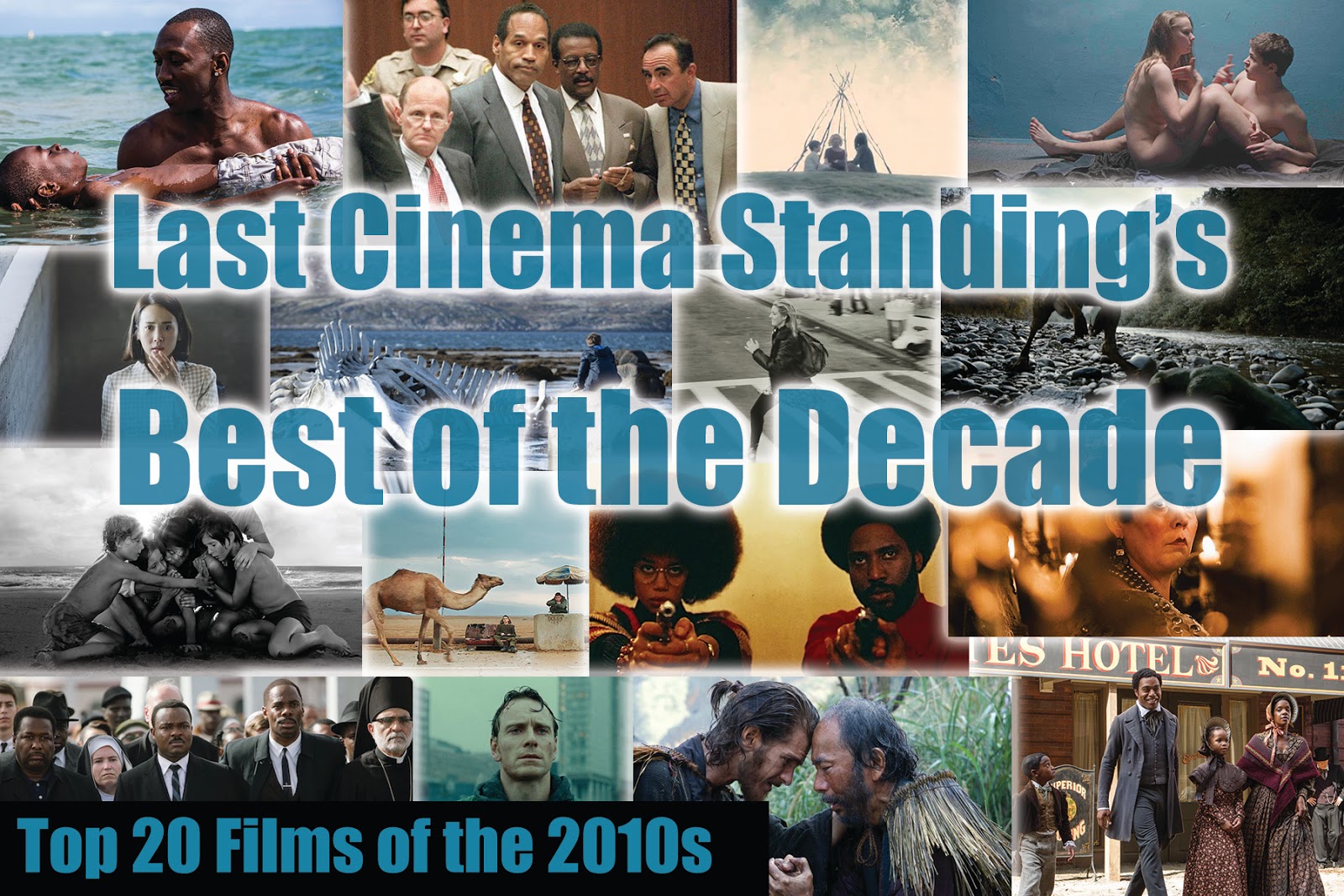
On the one hand, I feel compelled to dissect the decade in
film here in the intro. After all, 10 years, more than 1,000 movies watched,
thousands of performances seen, hundreds of thousands of words written by yours
truly and millions more out there in the world, it certainly seems as though it
all needs to be summed up, neatly and succinctly.
Maybe that cannot be so. The decade was too big to encompass
in one post here. Too much happened, on screen and off. No summary could
encapsulate it all. Perhaps I should just let the movies speak for themselves.
After all, they are magnificent films from wonderful artists that defined the
past decade and will live on to be seen, discovered, and appreciated in the
decades to come.
If we look closely enough, I think the story of our decade
is told in these 20 films. These movies reached beyond the cinema and helped us
understand something about the world around us, helped us make sense of all
this craziness – or helped us escape it for a short time. There are historical
dramas, tales of modern romance, science-fiction alongside documentary. There
are thrills, and there are laughs. There are moments that will make us cheer
and moments to make us cry.
The best films of the 2010s reflected the times in which
they were made but also staked out a hope for the future, a plan, a vision for
what comes next. It is not always a pretty vision, and we do not always make it
out okay, but then, sometimes we do. It is up to us, the viewers, the real
people leading everyday lives, to pick the future we want and to make it
happen. Because the future is coming, ready or not, and these are the decisions
for which we will be remembered.
Before we get to the list, here is a group of 20 more films that
landed just outside the top 20 (alphabetically): 127 Hours; Birdman;
Blank Panther; Calvary; Drive; Faces Places; Fences;
Force Majeure; Frank; The Kindergarten Teacher; The
Master; Moana; Mustang; Once Upon a Time … in Hollywood;
A Pigeon Sat on a Branch Reflecting on Existence; The Revenant; The
Shape of Water; Take Shelter; The Wolf of Wall Street; Weiner.
The Top 20 Films of the 2010s:
20. BlackKklansman, directed by Spike Lee

Spike Lee has his forbears, certainly – Charles Burnett,
Melvin Van Peebles, and frequent collaborator Ossie Davis among them – but I
think it is fair to say the current wave of talented black directors does not
get a foot in the door without the pioneering early works of Lee. He is not the
only one, of course, and filmmakers like John Singleton, F. Gary Gray, and
Keenen Ivory Wayans have all had a hand in the cause. But you can draw a direct
line from Do the Right Thing to Ryan Coogler’s Fruitvale Station.
From Malcolm X to Ava DuVernay’s Selma. From Crooklyn to
Barry Jenkins’ If Beale Street Could Talk.
Meanwhile, Lee’s own output remained steady in quantity but
uneven in quality, though his documentary work has always been stellar.
Finally, he won an honorary Oscar, and it looked like the industry was ready to
turn the page on Spike as a modern force. Then, he went and made BlackKklansman,
the most politically urgent and cinematically accomplished work he has produced
since perhaps 25th Hour. Lee cuts away all the fat and gets straight to
the heart of the matter in calling out the times for what they are and the
people responsible for what they have done.
Starring John David Washington and Adam Driver, BlackKklansman
is the story of a black cop who infiltrates the Ku Klux Klan. It would all seem
funny if the facts were not so ominous and the story not so relevant to today.
The whole enterprise is gripping, entertaining, and terrifying in equal
measure, but Lee saves the biggest gut punch for the final moments. He reflects
our own world back at us, and the image is as ugly as feared. There are true
villains out there, and BlackKklansman is not afraid to point fingers
and name names.
19. All Is Lost, directed by J.C. Chandor

J.C. Chandor made four features in the 2010s, and each of
them in some fashion deals with the manner in which the modern world forces us
to act in ways that are antithetical to our nature. Of these, the most
harrowing and heartfelt is All Is Lost. It is also the most abstract,
following as it does the story of an older retiree (unnamed in the script but
referred to as Our Man and played by our man, Robert Redford) who gets stranded
at sea.
While sailing alone, Our Man’s ship is struck and critically
damaged by a lost shipping container. From this point on, the film is almost a
silent procedural as Our Man undertakes the steps to save his own life, while
thwarted by the elements at every turn. Our Man is measured and resourceful,
fearful of death but unafraid to act. Redford plays him as a stoic but not
without humor or hope. In portraying Our Man, of course, he is portraying every
man, and every woman, and everyone.
The story at hand is so engrossing and the cinematic
elements in play so enveloping that it would be easy to miss the machinery at
work, the larger narrative churning away in the background. Ultimately, this is
where the modern world has left us, alone and adrift. Like 99 percent of us,
Our Man has no safety net, nothing to keep his head above water but the will to
do so. We are drowning ourselves, both figuratively and literally, and there is
no one coming to save us. So, like Our Man, it is incumbent upon each of us to
fight on, unafraid to act, to save ourselves.
18. Frances Ha, directed by Noah Baumbach

I first saw Frances Ha about a year before I moved to
New York City. As I write this, it has been nearly a year since I moved back to
California. My five years in New York felt like a lifetime, and yet, those
years flew by in a flash. New York is a place where you can do everything and
accomplish nothing, where you can see everything and somehow miss it all, where
you are surrounded by people yet know no one. All of it is right there, in
gorgeous black and white, in Greta Gerwig’s and Noah Baumbach’s ode to getting
your life together, but on your own timeline.
The 2010s were much of the world’s introduction to Gerwig,
who got her start in the indie Mumblecore scene in New York, though if you saw Lady
Bird, you know her to be a Northern Californian through and through. She
imbues the title character of Frances Ha with charm, resilience,
stubbornness, and pure chutzpah. She is the quintessential elder millennial,
saddled with debt, burdened by dreams, and unsure what to do in a world that somehow
has already left her behind. Maybe she won’t catch up and maybe she will, but
Gerwig gives us a character who will never stop running.
The other half of the equation is Baumbach, a filmmaker who
never met a cutting remark or satirical jab he did not like. For once in his
whole bitter, anxiety-ridden filmography – which I say with love, as I believe
his credits are superlative – he let the sunshine in. How could he not? Gerwig’s
presence practically demands it. Baumbach films New York like we have never
seen it before, finding hidden corners and new angles on familiar ones. It is
the ultimate collaboration, as Baumbach seems to be filming through Gerwig’s
eyes. Would that we could all see the world so fresh.
17. Shame, directed by Steve McQueen

Director Steve McQueen and star Michael Fassbender proved
how deep they could go into a character and a story in their first
collaboration, Hunger from 2008. With this, their second film together,
they showed there were still new depths to plumb and that they were the right
men for the job. Shame is the story of a sex addict who has pushed
everything and everyone of value out of his life to make room for only those
things that will satisfy his addiction. He is troubled, and he is pained, but
most of all, he is so very, very lonely.
McQueen finds that loneliness in every corner of his canvas,
in the crowded nightclubs and dark alleys, as well as the penthouse apartments
and swanky lounges. The loneliness is everywhere, and it is poisoning
everything it touches, most of all Fassbender’s Brandon. Even when his equally
lonely sister (Carey Mulligan) arrives at his door, her presence merely
amplifies the emptiness in his life. They are alone together, lost right where
they find themselves. They have neither the tools nor support to reach out, to
come together, to find a way out of the despair.
The world since the film came out in 2011 has only more come
to resemble the one depicted here, in these images of desolation, hopelessness,
and mindless, empty consumption. It is easier to be this way, disconnected and alone,
than it is to risk rejection, to risk humiliation, to risk our pride. So, we go
on like this. McQueen’s film argues that it is unsustainable, that there can
never be enough to satisfy us, to fill the void, because the void grows ever
larger. Ain’t that a shame?
16. Spotlight, directed by Tom McCarthy

Good people doing good work are rare on screen. I do not
know why that is, and one wishes there were more, if only to show there are
good people and there is good work being done. In Spotlight, we see that
the members of the investigative team at the Boston Globe do not work for
accolades, and they do not work for acclaim. They do not need a pat on the
back. They are obviously not in it for the money – there isn’t any. All they
want is for the world to see their work and take action. That is all any
journalist can reasonably ask. Good journalists give us the truth. It is up to
us what we do with it.
In an era replete with corruption and coverups, lies and
hypocrisies from the most powerful people in the land, perhaps no scandal was
more thoroughly disgraceful than that of the Catholic church. They held the
ultimate power, and they used it to commit the vilest crimes. Tom McCarthy’s
film is a step-by-step look at the Boston Globe’s investigation into these
heinous acts. McCarthy shows us the process of gathering evidence, interviewing
witnesses, and piecing together clues. This is the leg work lesser films skip
over in favor of flashy chases and grand statements. Good people doing good
work.
Despite how all of this may sound, the film is anything but
dry. On the contrary, it is riveting. Though most of us know the facts of the
case and how it turns out, McCarthy builds tension by interrogating his
characters’ beliefs. This is a world dominated by the church, filled with
people whose lives are grounded in faith. The Spotlight team’s work will shake
that foundation to its core, and they must all wrestle with that truth. But in the
end, it is the truth, and that is what they have sworn to uphold. Good people
doing good work. If only there were more.
15. Selma, directed by Ava DuVernay

Controversy has a way of attaching itself to works of art
and clouding our appreciation of them. It is ironic, then, that the controversy
around Ava DuVernay’s masterwork is that it was not appreciated enough. Though
nominated for Best Picture at the Academy Awards and a winner for Best Original
Song, the film failed to garner nominations for DuVernay as director, David
Oyelowo for his stirring lead performance, or any of the many deserving
craftspeople. The following year, #OscarsSoWhite was born.
The legacy of Selma, however, deserves to be greater
than a hashtag. There is a reason there was such consternation over the lack of
recognition, and the reason is that the film is utterly deserving of every
accolade bestowed upon it and denied to it. This is visionary work that –
forgive the cliché – brings history to life. Dr. Martin Luther King Jr. was a
historical figure, yes, but he was also a man. He was subject to the same vices
and capable of the same virtues as any of us. DuVernay and Oyelowo work to show
us that King was great not because he was perfect but because he overcame his
flaws.
By overcoming those flaws, he inspired people to action, and
through that action, change was achieved. Selma also demonstrates,
however, how fragile that change can be. We must all be guardians of progress,
we must all help to roll the boulder up the hill, and we must all be ready to
take on the weight of other boulders, of other fights. The tide turned for King
in Selma because people saw injustice placed before their eyes and said, “No
more.” But of course, there is always more. We still see it, it is still right
in front of us, and if we choose not to act, the consequences will be dire.
14. The Tribe, directed by Miroslav Slaboshpitsky

I do not think I have told this story in this space before,
so if you will allow: In June 2015, I was able to attend an early screening of The
Tribe at the Film Forum in New York. Director Miroslav Slaboshpitsky and
star Yana Novikova were on hand for a Q&A. The film earned every inch of
its reputation as a grueling descent into silent chaos. Grown men sobbed openly,
one audience member fainted and was removed from the theater, and general
madness swept over the crowd. The Q&A, conducted through multiple
interpreters, was a delight, and my partner (now wife) and I left the theater suitably
wowed.
You can read my report on all of that at this link. Here is
the part I never mentioned. After we left the theater, we bumped into
Slaboshpitsky on the street, jovially conversing with people he had just
traumatized, in a good way. He was kind and boisterous and generous with his
time and answers. Then, when asked what, if any, statement he was trying to
make with his film, he replied: None. Pressed for what The Tribe might
be about, he insisted nothing, that he was simply trying to tell a good story.
I think of this story often when considering artistic intent and whether
intention has anything to do with reality.
The Tribe is a lot of things, and no matter what
Slaboshpitsky would have you believe, it is certainly about something. What you
take from it will depend on your willingness to investigate your own ideas
about tribalism, peer pressure, and the madness of mobs. But if you can do
that, and if you can stick with the film’s lengthy single takes, and if you can
stand the silence of a movie shot entirely in Ukrainian sign language without
subtitles, then you will be rewarded with a film that speaks nothing but says
everything.
13. Parasite, directed by Bong Joon-ho

In a 20-year feature career, writer-director Bong Joon-ho,
affectionately referred to as Director Bong throughout the 2019 awards season,
has made just seven films. He followed his universally beloved second film, Memories
of Murder, with creature feature The Host, which brought him
international attention and acclaim. Once he made the jump to Snowpiercer
(2013) and Okja (2017), featuring big Hollywood stars and studio money,
it appeared he was fully prepared to join the mainstream. Now, we get Parasite,
and instead of going to the mainstream, Bong has made the mainstream come to
him.
The director’s latest has been described a thousand
different ways, and none of them is wrong. Parasite is a class-warfare
drama, an Ocean’s-style heist flick, an absurdist comedy, and a
panic-inducing thriller. It has won awards from just about every critics group
under the sun, it has the Academy stamp of approval, and it has made more than
$25 million in the U.S., which is seismic for a South Korean film with no
familiar stars – never mind that Song Kang-ho is internationally renowned and
the film is a $100 million blockbuster in its native Korea. This is Director
Bong’s world, and we are just living in it.
With all the acclaim and the hoopla and the parties and
awards, though, it can be easy to forget just what made this twisting tale
worthy of all this attention in the first place. And make no mistake, Parasite
deserves all the accolades coming to it and more. The story is as universal as
it comes, a fable about rich vs. poor, poor vs. poor, and the rich vs.
everyone. It is about the chasm that exists between the elite and the
underclass on whom they rely, without whom their comfortable lifestyle would be
unattainable. Bong posits a system much like our own, in which everyone is
leaching off someone, in which there are no heroes or villains, and all that
matters is what you can take.
12. Silence, directed by Martin Scorsese

More than three years since Silence was released in
theaters, I am still trying to understand the shrug with which it was met. It
boggles the mind. You have Martin Scorsese directing one of his life’s passion
projects, featuring magnificent performances, all-time great cinematography,
and exploring some of the deepest, most resonant themes imaginable. All of
that, and it seemed there was a collective sigh when it hit theaters. The $7
million domestic box office take is essentially what forced Scorsese to Netflix
to make The Irishman. Without Leonardo DiCaprio in the lead, no one
wanted to put money on a Scorsese movie.
I understand the hard sell and the tough sit that is Silence.
On paper, it is a nearly three-hour slow burn about 17th century missionaries
grappling with their faith. Not a traditionally family-friendly crowd pleaser,
though it may not surprise you to learn my wife, then fiancée, and I caught it
in theaters as our Christmas night movie that year. But this is Scorsese, and
this is the movie he waited his whole life to make, the story he has been
building up to from Who’s That Knocking at My Door to The Last
Temptation of Christ to Kundun. This is the closest we will ever get
to looking directly into Scorsese’s soul, and no one cared.
The film, however, is still out there, and it is not going
anywhere. We still have Andrew Garfield’s brilliant performance as Rodrigues, a
man trying to make himself in Christ’s image but whose vanity and
self-importance weigh him down. We still have Rodrigo Prieto’s misty
mountainside photography, Dante Ferretti’s and Wen-Ying Huang’s deceptively
minimalist sets, and the measured, steady pacing of editor Thelma Schoonmaker.
It is all still out there, waiting to be discovered by us. But that is where
Scorsese has always been, out in front of us, waiting for us to catch up.
11. Amour, directed by Michael Haneke

By the time the 2010s rolled around, Michael Haneke was
firmly in the “lifetime achievement” phase of his career. He was approaching 70
years old. He had spent more than 20 years making darkly probing dramas about
the fundamental flaws in humanity that bring us so much pain. And in 2009, his
disturbing deconstruction of the foundations of fascism, The White Ribbon,
finally won him the Palme d’Or. Then he went out and won the damn thing again.
Amour is of a piece with Haneke’s filmography, but it
also stands apart. While all of his films in some way investigate ideas of
betrayal and loss and culpability, Amour takes these themes and brings
them inside the home. We watch as our main character’s body and mind betray
her, as her husband grieves the excruciatingly slow loss, and as everyone
searches for someone to blame for a pain that seems inexplicable. Amour
is Haneke’s most intimate and personal film, and thus, it is also his most
painful. While the characters wonder why this is happening, Haneke seems to be
saying: How else would you expect this to go?
Emmanuelle Riva and Jean-Louis Trintignant are stunning as
Anne and Georges, a husband and wife, long since retired from their jobs as
music teachers, who pass their time going to concerts and simply enjoying their
time together. Riva, I have written about in this series, but Trintignant has an
equally difficult task, playing a man watching the love of his life slowly slip
from his grasp and knowing there is nothing he can do about it. His pain is
palpable, and his loneliness is real. No one expected this much honest emotion
from Haneke, but it is right there in the title. Yes, of course our bodies will
betray us – that is what they do – so the only question is how much pain we are
willing to endure for love.
10. 45 Years, directed by Andrew Haigh

What is left in a marriage when trust is gone? Can it be
rebuilt? Even if so, can things ever be like they once were? Writer-director
Andrew Haigh poses these questions and more in his probing, insightful look at
the fragility of the bonds we spend our lives building. 45 Years is not
so much about the dissolution of a marriage as it is the slow unravelling of
the ties that could bind any of us together. It wonders how shaky the
foundations of any relationship are and whether a single crack can widen until
the ground beneath us fully gives way.
Charlotte Rampling plays Kate in the best performance of a
long career (and one I wrote about in the performances of the decade piece).
She is married to Geoff, played by Tom Courtenay, who is equally superb. They
have been married nearly 45 years and are planning a big anniversary blowout
when we meet them. Then, Geoff receives word that an ex-girlfriend who went
missing on a hike decades before has been found, her preserved body discovered
in a thawing glacier. This one piece of news casts a shadow over Geoff and Kate’s
relationship, a darkness that grows with each passing day as Kate is forced to
reckon with the truth about the man to whom she has devoted her life.
Their circumstances are specific to them and to the film, but
it could happen in any number of ways to any of us. The past – here, a young woman
persevered in youth forever – is always perfect. Our minds have a way of ironing
out the flaws, and in this way, we can go on, unburdened by grievances and undisturbed
by traumas. But that perfection is a kind of trauma in and of itself. The past
haunts us, waving its idyll in our faces, forcing us to question what we have
right now. Is this all we need, all we want? Can we ever be satisfied? Can we
ever move on? And if 45 years is not enough time, could there ever be enough?
9. The Favourite, directed by Yorgos Lanthimos

There has never been a costume drama like this before, and
unless director Yorgos Lanthimos decides to go back to the well, there probably
never will be again. Be honest. When you heard 18th century England and a power
struggle in the court of Queen Anne, you thought: stuffy, dull, old fashioned,
etc. Perhaps some of those descriptors would have occurred to me, as well, if
not for the fact that Lanthimos is one of the finest filmmakers in the world
right now. He has yet to make a film that could be described as stuffy or dull,
so when I heard he was taking on British royals in the 1700s, my first thought
was: yes, please. The Favourite does not disappoint.
The film is everything you could ever want at the cinema. The
cast is spectacular, the script is riotously funny, the crafts are consistently
adventurous, and the story strikes at the very heart of the monarchy and our
cultural obsession with wealth and power. The film follows two members of the royal
court, Sarah (Rachel Weisz) and Abigail (Emma Stone) jockeying for position and
favor with the queen (Olivia Colman). They torture each other emotionally and
physically, finding weak spots in each other they might never have known were
there. All they want is a little more – a little more power, a little more
money, a little more of everything.
Of course, a little more is never enough and the cycle
repeats. They want more so they take it by any means necessary. At a certain
point, the gluttony becomes an end to itself, and by the conclusion, even the
winners wonder what they have truly gained. We watch, thrilled and amazed by
all of these goings on, but Lanthimos never lets us off the hook. He toys with
our compassion and our loyalties until the final moments arrive and we wonder
how we could have wished for any of this and what it says about us that we did.
8. Moonlight, directed by Barry Jenkins

On paper, every element of Moonlight looks like a
gamble. It starts with the story, by playwright Terrell Alvin McCraney, about
the coming of age of a poor, gay, black youth in Miami. There is the director,
Barry Jenkins, who had made just one feature eight years prior. There is the
cast of mostly unknowns, apart from Naomi Harris, who featured in the Pirates
of the Caribbean series, and Mahershala Ali, who began the decade a
talented journeyman television actor and ended it a two-time Oscar winner.
Finally, there is the fearless way in which all of these elements are put
together by Jenkins, whose brilliant work turned a gamble into a sure thing.
The story of Little/Chiron/Black (Alex R. Hibbert/Ashton
Sanders/Trevante Rhodes) is unlike any we have ever seen on screen. The
characters are unlike any we have ever met. In lesser films, this story and
these lives would be played for cheap sympathy and easy drama. The particular
genius of Moonlight is that Jenkins treats all of his characters with
respect and empathy, foregrounding the experiences of people who are often
overlooked and underrepresented. Jenkins makes these lives important,
demonstrating what happens when a filmmaker gives marginalized voices the kind
of care and attention usually lavished upon the white heroes in 90 percent of
films.
In navigating these tricky waters, Jenkins never steps
wrong. Moonlight is a kaleidoscope of human emotion, twisting and
turning and revealing new shapes and colors throughout its runtime. It would be
disorienting if we were not in hands as sure and steady as Jenkins’. This leads
to the obvious question, which has an even more obvious and depressing answer:
Why did a director this clearly talented have to wait eight years before making
his second feature? The system is broken, that’s why, and until it is remade in
the image of filmmakers like Jenkins, films like this will always seem like
happy accidents, happy though they may be.
7. Roma, directed by Alfonso Cuarón

It was inevitable Alfonso Cuarón would marry the gentle humanism
he displayed in early films such as A Little Princess and Y Tu Mamá
También
with the technical bravura showcased in Children of Men and Gravity.
But it is one thing for a filmmaker to be capable of such a union, while it is
quite another to pull it off as masterfully as Cuarón does here. From the gorgeous
black-and-white cinematography to the immersive sound design, Roma is a
crafts marvel buoyed by the deceptively simple tale of domestic worker Cleo
(Yalitza Aparicio) and the family for which she cares.
Roma revels in the details of lives lived and in
the small moments that pass by unnoticed by most of us. The film is unafraid to
give its characters a quiet moment on a rooftop and let us hear the dogs
barking and children laughing in the neighborhood. Cuarón stages massive set
pieces like the burning of a forest against the mundanity of a family watching
TV and inviting their domestic worker to join them. The film’s grandest
sequence is a melding of the two as Cleo goes into labor in the middle of an uprising.
This moment finds a perfect balance in the human drama in front of us and the
full-scale riot going on all around us.
Cuarón made the film as a tribute to the domestic worker who helped
raise him as a child, and some critics bristled at the thought of a wealthy artist
purporting to speak for a poor native woman. This led to a conversation about
who has the right to tell what stories, which is a fine conversation to have,
and it would have some validity if more poor domestic workers had a chance to
tell their stories within the Hollywood machine. Unfortunately, that is not so.
Thus, we rely on honest, empathetic work from filmmakers like Cuarón to give a
voice to the voiceless. At its most altruistic, film is a medium that offers a
window into lives we will never know. That is Roma, and only Cuarón
could have shown us this view.
6. The Tree of Life, directed by Terrence Malick

One of the more surprising developments in film this past
decade had to be the transition of Terrence Malick from reclusive genius into
prolific auteur, seemingly out of nowhere. From 1973 to 2010, Malick made just
four films. Over the past 10 years, he has made five features, three shorts,
and an IMAX documentary. He is already in postproduction on his next feature.
Whatever precipitated this sudden creative burst, its clear beginning is here
in The Tree of Life.
The director’s signature style has been around since at
least his second feature, Days of Heaven in 1978. That style reaches its
zenith here, so much so that in his subsequent films, it became something of a
crutch. Much of his output in the 2010s had the look and feel of a Malick film
but lacked the emotional core that is in evidence here. Cinematographer
Emmanuelle Lubezki’s stamp is all over this film, and he should have won his
first Oscar for it – he had to wait two more years, then he won three in a row.
The voiceover, another Malick signature, is illuminating and vital, while the
themes are at once specific to his characters and universal to us all.
The Tree of Life is epic in scale, flashing back, as
we discussed in a previous piece, to the origins of all life in the universe.
Its strength, however, lies in the specificity of its characters and the care
taken to make their lives feel as important as the big bang. In particular,
Jessica Chastain and Brad Pitt are excellent, but special mention must be made
of Hunter McCracken, who portrays the two stars’ son in the film and is
absolutely stunning in his only film role to date. Their family bond is tested
over and over again, but as everything around them fades and the universe grows
emptier, the only thing left for them is that connection and the memories of
what they once had.
5. Foxtrot, directed by Samuel Maoz

War seems to be a perpetual state of being. Humanity divides
itself into factions, then factions of factions, based on nationality, or
religion, or skin color, or economics, or all of the above. Those factions then
fight over what they believe is owed to them, the land or money or status they
think they deserve. Win or lose, time passes, the divided reshuffle into
further divisions, and it begins again. In the end, we are all debased. Foxtrot
is about that debasement, about the fools war makes us into, about the cruelty
we are asked to perpetuate and the ways we do so willingly.
Samuel Maoz’s film is no traditional war picture, though.
There are no big battle scenes but those playing out within ourselves. Following
one Israeli family and the horrors the war machine visits upon them, Foxtrot
is a plea for sanity in an obviously insane world. It asks us to consider why
we are fighting and whether we are truly fighting for anything. We see the
people back home as they struggle to cope with loss. We see the soldiers in the
battlefield, just kids put in life or death situations when they have little
understanding of either concept. We see the devastation wrought, not by bombs but
by the very nature of war.
This machine of death relies on hate. It requires us to be
our worst selves. It knows we will betray our better natures in service of it
because war has always been with us, and as far as we can tell, it always will
be. We cannot see our way out from inside its spinning wheels and rotating
gears. We send young people off to die because young people have always been sent
off to die. We do not question it because we do have the words to form the
question. Perhaps, we do not want to hear the answer because deep down, we know
the machine cannot exist without our permission, which makes us the monsters.
4. Leviathan, directed by Andrey Zvyagintsev

That we are still in this mess is perhaps the most shocking
thing about Andrey Zvyagintsev’s epic indictment of dictatorial rule and
governmental oppression. In fact, it has only gotten worse. Zvyagintsev was
born in Russia at the height of Soviet power, less than two years after the
Cuban Missile Crisis. He watched his country torn apart and ravaged and
exploited by those in control. He and his countrymen have seen the rise and fall
and rise again of authoritarianism. Zvyagintsev takes all this pain and
experience and puts it on the screen in his bleak vision of a world lost to the
powers that be.
Hewing closely to the story of Job, Leviathan is the
story of a man and his family whose comfortable life is upended on the whims of
a local politician. The man, Nikolay (Aleksey Serebryakov), determines to fight
to protect his family and his property, and misfortune upon misfortune is
visited upon him for his insolence. While the biblical Job is tormented by God
and Satan, Nikolay’s punishments are doled about by the self-styled gods and
devils around him, the rulers who take authority as their right and wield power
as baton, striking all those who would rise up against them.
Where in the world can we turn and not see this dynamic
played out over and over again? We get what they give us and no more. If we ask
for more, we are beggars. If we ask for equality, we are out of line. If we
work hard, we are told to work harder. They make their petty rules and change
them as they see fit. It is their game, and all we can do is try to win. Leviathan
is about what happens when we play and inevitably lose. “Remember the battle
and do so no more … Whatsoever is under the whole heaven is mine.” – Job 41:8-11
3. Melancholia, directed by Lars von Trier

The end of everything never looked so beautiful, nor so
inevitable. Lars von Trier is a provocateur par excellence, just witness the
Cannes press conference that followed this film’s premiere. But he is also an
artist capable of producing works of great depth and feeling. The trade off we
make for the ill-considered comments, dumb controversies, and silly feuds is to
receive films like Breaking the Waves, Dancer in the Dark, Dogville,
and this, his crowning achievement.
When it appeared in 2009 that von Trier had gone as deep
into the darkness as was possible to go with Antichrist, no one knew
that his next film would find further depths to explore. Melancholia is
not a film about depression. It simply is depression, writ large, on the
biggest canvas imaginable. The film understands on a fundamental level that the
throes of depression can feel like the tendrils of the earth are reaching out
and pulling you deeper into the blackness. Depression is hopelessness,
emptiness, nihilism, and Justine, as played by Kirsten Dunst, is the embodiment
of all these experiences.
The film opens with a series of extreme slow-motion shots,
showing us the final days, final hours, and final moments of these people’s
lives. Where other directors and lesser films would use this device to preserve
the preciousness of these images, von Trier uses these shots to prolong the
suffering of his characters. The longer this goes on, the more pain they, and
by extension we, feel. But still, the end is coming, and when it does, it will
be the end of everything. As Justine tells her sister: Life is only on earth –
and not for long.
2. O.J.: Made in America, directed Ezra Edelman

Contained within these 467 minutes is the entire modern
history of the United States. This is the mockery that is the criminal justice
system. This is the antagonistic force law enforcement has become. The
degradation of the media. The obsession with the celebrity. This is the
addiction to sensationalism. In telling the story of O.J. Simpson, the murders
of Nicole Brown and Ronald Goldman, and the subsequent trial, director Ezra
Edelman show us what it means to have been a black man alive in America for the
past 60 years.
The length is necessary to provide all the context lesser
documentaries would hint at or gloss over. By taking his time and building his
case brick by brick, Edelman is able to reflect the world back at us in ways we
have rarely if ever seen on film. We see riots, protests, and police shootings.
We see a world on fire. Into this milieu is dropped Simpson, a superior athlete
and seemingly squeaky-clean presence. He stands at the nexus of white America
and black America, and Edelman uses this figure to explore everything that
happens when these two worlds collide.
There is no trickery here, and though full of directorial
style, Edelman does not need flash when his film has so much substance. The
pieces were always out there, waiting to be put together. This is what makes
Edelman’s accomplishment so impressive. When laid out before us, the puzzle is
impossible to ignore and its picture is clear. We made a monster into a martyr
and turned a murder investigation into a circus. It was dubbed the Trial of the
Century, as if it were a ready-made television event. Edelman takes that
moniker and turns it back on us, putting our century on trial. The verdict:
Guilty. The sentence: Well, look around.
1. 12 Years a Slave, directed by Steve McQueen

First, the images come to mind. The wheel of a
paddle-steamer cutting through the water with its ruthless efficiency and
ceaseless consistency. The blood and flesh spraying from black bodies, abused
beyond recognition. The muddy feet of a slave, who has been strung up by the
neck, as he struggles to keep his toes in contact with the ground. All that
cotton. Then, the emotions hit you. The pain, the hopelessness, the
incomprehensibility of it all. The wonder at how this could have happened, not so
long ago, and how it is still happening. And the realization that no one did
anything, and that we are not doing enough.
Steve McQueen’s 12 Years a Slave is a masterpiece
that recognizes slavery for what it is: a stain on human history that can be
neither washed away nor covered up. Its effects are felt today, and this film
is a rejoinder to all those who would say the Civil War ended more than 150
years ago, who say get over it, who defend the Confederate flag as a symbol of
pride, who do not understand why we have to reiterate that black lives, in
fact, matter. This is the evidence. This is what was done. This is what your
confederacy fought to defend. These are the lives that did not matter in their
time. McQueen’s film makes certain they will matter now.
It is not just the film’s import, however, that makes it
great. The performances across the board are unimpeachable, from Lupita
Nyong’o, Chiwetel Ejiofor, and Michael Fassbender to Paul Dano, Alfre Woodard,
Sarah Paulson, and Paul Giamatti. Sean Bobbit’s cinematography, Adam
Stockhausen’s production design, Hans Zimmer’s music, and Joe Walker’s editing,
all the way down the line, there is not a craftsperson delivering anything less
than perfection. And, of course, there at the helm is McQueen, guiding all of
these perfectly assembled parts to the finish line.
As we enter another decade, unsure of what the future holds
or what the world might look like at the end of another 10 years, the
responsibility rests with all of us to make our piece of it better. That starts
with remembering where we came from and how we got here. The past is
ever-present in very real ways, and we cannot move forward if we do not look
back and learn. This film demands that we confront the past, that we face up to
who we are and what we have done. For these reasons, 12 Years a Slave is
not just the best movie of the decade, but one of the best films ever made. It
is our honest history, and what we do with that truth is up to us.
___
Thanks for being a part of the Last Cinema Standing Best
of the Decade series. We’ll have one more post with some odds and ends,
wrapping things up, then hopefully, back to regular coverage in 2020 and beyond.


