Showing posts with label Best Animated Feature. Show all posts

Saturday, March 2, 2024

Countdown to the Oscars: Best Animated Feature


Welcome to this year’s edition of Last Cinema Standing’s Countdown to the Oscars, where we will break down each of the 23 categories, analyze the films, and make some guesses at their awards prospects.


Best Animated Feature


The nominees are:


The Boy and the Heron

Elemental

Nimona

Robot Dreams

Spider-Man: Across the Spider-Verse


Last year, we talked about a potential changing of the guard in an Animated Feature category that has long been dominated by Disney and Pixar. Netflix was finally able to break the near stranglehold those two giants of animation have had on the category, taking Guillermo del Toro’s Pinocchio all the way to the win. But, still, let’s take a look at the last 11 years of winners by studio:


2012 - Pixar

2013 - Disney

2014 - Disney

2015 - Pixar

2016 - Disney

2017 - Pixar

2018 - Sony

2019 - Pixar

2020 - Pixar

2021 - Disney

2022 - Netflix


Obviously, one year does not a trend make. But two? Now, that would be a story. There is no Disney nominee this year. Pixar is back in the running with Elemental, and Netflix has returned to defend its crown with Nimona.


But, what’s that little blip in 2018? It’s Sony, the only studio to prevent Pixar and Disney from an unbroken 10-year streak of dominance. And, wouldn’t you know it, Sony is at it again with a sequel to the very film that took home that Oscar. If Sony’s Spider-Man: Across the Spider-Verse can follow up on Netflix’s win last year, then maybe we can really start talking about that changing of the guard as more than just theoretical.


The Boy and the Heron

If this is legendary director Hayao Miyazaki’s swan song, then he has pulled out all the stops. The opening sequence, depicting a hospital fire and the surrounding chaos, is one of most beautifully executed scenes of the year, animated or live action. That said, there is an element of Miyazaki bingo to this film, right down to the gaggle of old grannies, the prominence of the natural world, and the protagonist’s journey to a strange, unknown land. By the end, it feels as if Miyazaki is reaching for something quite profound. I’m not sure he gets there, but maybe he’s simply reaching beyond me.


Elemental

Take this however you want, but I would call Elemental mid-tier Pixar. Now, Pixar is one of the great American movie studios of all time, so its middle tier can stand alongside just about anybody else’s top tier. And, undoubtedly, worse Pixar movies than this have won this very prize.


This Romeo and Juliet story of a fire person and a water person (it’s a city of elements, you see) falling in love is sweet and lovely to look at and has some interesting ideas about being the child of immigrants. Still, there is an emotional richness lacking here that can be found in abundance in the studio’s best work. I am, perhaps, being a little too harsh – especially since I enjoyed this movie – but such are the perils of setting the bar so high.


Nimona

From what I can tell, this film makes a lot of people feel very good and very seen. That’s great. Everyone deserves to see themselves at the movies. I celebrate that fully. It didn’t work for me. It’s great to see gay love stories on screen. We need more of them. But, this movie is at once too complicated and too simple for its own good. 


It follows a commoner who becomes a knight and falls in love with another knight before he is framed for regicide and goes into hiding, where he meets a little girl who is excited by the prospect of villainy because she is secretly a shapeshifter who has been outcast from society. Confused yet? That’s not the half of it.


There’s a nice message in here, but the plot mechanics are working overtime to keep the audience involved when a deeper connection to the characters would have worked just as well. I also found the animation itself unpleasant to look at, but I’m sure there’s an animation expert out there who can tell me why I’m wrong.


Robot Dreams

When I tell you the two films I cried the hardest at this year were this and All of Us Strangers, you will understand that this is a five-hanky tearjerker. This wordless tale of a dog and his robot companion touches on themes of loneliness, isolation, love, loss, and grief, all while reclaiming Earth, Wind, and Fire’s “September” as the out-and-out banger it so clearly is.


I attended an advance screening of this film where director Pablo Berger spoke and answered questions afterward. One audience member stood up and said that he had been through a devastating breakup recently and that this movie healed him. It seemed as though Berger may have heard similar things at other screenings. It’s not hyperbole. It’s a truly powerful little story, and if not for a certain superhero, this would absolutely be competing for best in show in this category.


Spider-Man: Across the Spider-Verse

And, what do you know? Here’s a certain superhero now. Into the Spider-Verse, the Oscar-winning first film in this series, was a phenomenon that took everyone by surprise. We’d rarely seen animation like that. The complexity of the storytelling was unparalleled. The diversity of the cast was commendable. It was a true work of art, which meant expectations for this followup would hover somewhere around the top of the stratosphere. How could any sequel live up that kind of reputation?


Well, Across the Spider-Verse not only lives up to it but surpasses it in nearly every respect. The storytelling is even more complex. The cast of characters is even deeper. And, the animation is some of the finest computer-generated imagery ever produced. It is a triumph. If there is one flaw, it is that this is half a movie, doing quite a bit of table setting for the chapter to come, but it is possible to overlook that flaw when the rest of the work is so transcendent.


The final analysis


Some voters may feel compelled to recognize Miyazaki for his final film. It’s also his biggest domestic hit by a country mile, and that’s not nothing. Still, it seems unlikely that anything is going to take down Spidey. Sony has a cultural force on its hands with these movies, and not even the combined forces of Miyazaki, Pixar, and Netflix, not to mention a robot with a dream, are going to stand in the way.


Will win: Spider-Man: Across the Spider-Verse

Should win: Spider-Man: Across the Spider-Verse

Should have been here: Teenage Mutant Ninja Turtles: Mutant Mayhem


A note about my favorite snub: Director Jeff Rowe’s Mutant Mayhem is so much fun. I’m not saying it’s high art, though the animation style is tremendous, but it has the gonzo energy of a Lord and Miller production like The LEGO Movie or The Mitchells vs. the Machines. All popular entertainment should be this exciting and strange.

Monday, March 6, 2023

Countdown to the Oscars: Best Animated Feature


We’re counting down the days until the Academy Awards! We’ll be here, breaking down each of the 23 categories, talking a bit of history, and trying to figure out who is going to win all those gold statues. So check back throughout the next three weeks for Last Cinema Standing’s Countdown to the Oscars.


Best Animated Feature


The nominees are:


Guillermo del Toro’s Pinocchio

Marcel the Shell with Shoes On

Puss in Boots: The Last Wish

The Sea Beast

Turning Red


This is the best chance yet for another studio to break the stranglehold of Disney-Pixar on this category. We went in depth on the numbers last year, but just to refresh: In 21 years, Pixar has won this award 11 times, Disney four times, and Dreamworks twice. Among last year’s nominees were two Disney films and a Pixar production. Disney’s Encanto took home the award. 


Pixar and Dreamworks are back again this year with a nominee each, but they look more vulnerable than ever to a pair of surprising challengers. We talked about Netflix last year as a likely major player in this category for the foreseeable future as the streamer has the money and the motivation to chase down a win here. Fittingly, two of this year’s nominees come from Netflix. The other is a fascinating independent experiment with some big-name backers. 


However all of this shakes out for the 2022 Oscars, what will be more fascinating will be to watch the coming years: Is there a changing of the guard happening and what will it mean for the future of animation?


Guillermo del Toro’s Pinocchio – I watched three versions of the Pinocchio story in 2022. In anticipation of the coming adaptations by Robert Zemeckis and Guillermo del Toro, I fired up Disney+ and watched the 1940 Disney animated feature with which most folks are familiar. It had been decades since I had last seen it, and I wanted to refresh my memory. The animation is strong, but the basic story has some problems that no adaptation has yet solved. The Zemeckis “live-action” version is a strange beast, indeed, though it did not deserve quite the level of hate it received. However, del Toro’s version, I think, highlights the pitfalls of this story.


Del Toro is a wonderful filmmaker, a tremendous visual stylist, and seemingly an all-around nice guy. The designs of the stop-motion puppets used in this Netflix-produced adaptation are singular and instantly recognizable. The director makes a few interesting story choices with the Blue Fairy and tellingly converts the familiar tropes of Pleasure Island into a fascist boys camp. He has a lot on his mind, and the movie is consistently visually inventive, and yet, I could not help but feel my attention wane. Perhaps there is something in the story of a puppet who longs to be a boy that lacks appeal to me. 


Here’s what I think is the main problem in every version of this story I have seen and certainly with the three I watched in the past year: Pinocchio is kind of a cypher as a character. Though he has clearly defined wants and goals, he mostly wanders haphazardly through the events of the story. Things just happen to him, and it’s a lot to ask an audience to be stuck with a character this guileless for the length of a feature. Guillermo del Toro’s Pinocchio is fine and clearly a labor of love. It’s the best version of this story I have seen, but I think the ceiling might be a little low on this beloved tale.


Marcel the Shell with Shoes On – I mean this in the nicest way possible because I genuinely loved this movie, but this is absolutely the hipster pick. Distributed in the US by A24 and produced independently, this adaptation of a series of viral web shorts grabs hold of your heart strings and never lets go. The story is as simple as it comes – a little shell, voiced by co-creator Jenny Slate – wants to be reunited with his family. But, writers Slate, Nick Paley, and Dean Fleischer Camp, who also directed, tap into the thematically rich veins of love, loss, and grief.


Isabella Rossellini voices Marcel’s grandmother, Nana Connie, and provides the best evidence yet of the need for a voice acting category at the Academy Awards. In just a few short words, Rossellini conveys a lifetime of experiences and regrets. It is magnificent work that helps ground the second half of the story in recognizable human emotion, despite the fact that these are inch-tall shells. By the end, you feel much the same as the human characters in the film: devoted to the happiness and wellbeing of this little guy trying to navigate a big world.


Turning Red – It has been so long since Domee Shi’s excellent Pixar-backed film came out – as of Oscar night, it will have been exactly one year and one day – that it might be easy to forget how much of a cultural lightning rod it became upon its release. Much of the faux controversy, which nonetheless led to some real insights, centered on one particularly tone-dead and wrongheaded review of the film by a white male writer who saw no value in the story of a young Chinese girl from Toronto and her coming of age.


The inanity of this argument is hopefully self-evident and I have no interest in re-litigating it here. This is only to say that for a few weeks there, Turning Red was at the center of an important cultural conversation. Now, a year later, it’s hard to remember this film being at the center of anything. It is a lovely story of friendship, forgiveness, and the difficulties of growing up and honoring yourself and your family, but it feels like its release at the beginning of the year sapped any potential momentum for a win. Otherwise, this would be a very traditional frontrunner in this category.


Puss in Boots: The Last Wish – On the other end of the spectrum, you can see the latest installment in the Shrek/Puss in Boots franchise in theaters right now. I did. The film has been the recipient of quite a lot of breathless praise and somewhat confoundingly is ranked No. 99 on the list of greatest films of all time on the cinephile website Letterboxd. Chalk it up to recency bias or perhaps the generally poor quality of most other kids films, but essentially, people lost their minds over this movie.


It’s a bit much, and that’s coming from someone who generally liked the film. I have only seen the first Shrek movie and never saw the first Puss in Boots, but I was entertained throughout. Antonio Banderas and Salma Hayek are winning as the central heroes, and the action scenes are well executed, but I have read multiple reviews refer to these as some of the best action sequences of the 21st century. That just ain’t so. It’s hype the movie can’t sustain, but if you meet it on its terms, the experience is quite fun and charming.


The Sea Beast – The same can’t be said for the other Netflix entry in this year’s lineup, which starts out strong but loses steam around the halfway mark then fizzles out by the end. The film follows a young girl who wants to hunt monsters as she tags along with a monster hunter who wants to make a name for himself. The monsters ultimately turn out to be more than meets the eye. It’s a fun, intriguing premise, but the movie ties itself in knots in the third act as it introduces so many villains and plot twists that by the end you forget exactly what it is you’re rooting for. And, this might be picking nits, but I thought the design of the monsters – a place where this movie should shine – left a little something to be desired.


The final analysis


Now is a good time to talk about the animation styles of these movies. Turning Red, Puss in Boots: The Last Wish, and The Sea Beast are all computer animated, resembling virtually all the other winners in this category over the years. Meanwhile, Guillermo del Toro’s Pinocchio is fully stop-motion, and Marcel the Shell with Shoes On is a stop-motion, live-action hybrid.


In the 21-year history of this award, only twice has it not gone to a computer animated film. The first time was in 2002, the second year of the award, when Hayao Miyazaki’s breathtaking hand-drawn work on Spirited Away earned the Japanese master his first and, to date, only Oscar. The second was the Aardman Animation stop-motion horror-comedy Wallace & Gromit: The Curse of the Were-Rabbit in 2005. For the past 16 years in a row, all computer-generated films. I expect this year to break that streak.


If we are going to invent a battle here, it is between the del Toro film and the little shell that could, but I actually think Pinocchio is way out in front. It has already won a ton of awards, del Toro is a beloved figure in the Academy with two Oscars to his name already, and as mentioned up top, Netflix has money to burn on pushing this film over the finish line. If it does win, it will be an exciting precedent breaker for this category and will open up the door to a potentially exciting future for animation at the Academy Awards.


Will win: Guillermo del Toro’s Pinocchio

Should win: Marcel the Shell with Shoes On


Next time: Animated Short

Friday, February 17, 2017

Countdown to the Oscars: Best Animated Feature

Zootopia is nominated for Best Animated Feature.

Welcome to Last Cinema Standing’s Countdown to the Oscars, our daily look at this year’s Academy Awards race. Be sure to check back every day leading up to the ceremony for analysis of each of the Academy’s 24 categories and more.

Best Animated Feature


The nominees are:

Kubo and the Two Strings
Moana
My Life as a Zucchini
The Red Turtle
Zootopia

Best Animated Feature is a studio game, plain and simple. This is the 16th year since the category became official at the Oscars, and in that time, there have been 64 nominated features. Of those 64, 31 have come from just three studios – Pixar (Disney Pixar), Disney, and Dreamworks. Of the 15 winners, not counting this year of course, those three studios have accounted for 12. The boom in independent animation has been wonderful for the industry, but if you want to win an Oscar, come with big boys or don’t come at all.

This year represents one of the few times Pixar had an eligible feature (Finding Dory) that failed to get a nomination, but Disney made up for it with a double nomination (Zootopia and Moana). Japanese animation house Studio Ghibli earned its sixth nomination with its first non-Japanese production (The Red Turtle), and Laika picked up its fourth nomination (Kubo and the Two Strings) for its fourth film, a perfect record that so far has produced zero wins. French-Swiss co-production My Life as a Zucchini is the only independently produced nominee, and not coincidentally, it is the least likely winner.

*Note: Full disclosure, I have not yet seen My Life as a Zucchini, which will not be released here until Feb. 24, two days before the ceremony. I will write about it in this space once I have had the opportunity to see it.

Zootopia (directed by Byron Howard and Rich Moore)Zootopia has been the animated movie of the moment pretty much the whole year. Its clever examination of race relations and prejudice teaches viewers a valuable lesson, and it is also undeniably entertaining and hilarious. Released early in 2016, as the U.S. presidential election truly was beginning to ramp up, it felt important and relevant then, and it has only grown more so as events in this nation have unfolded.

The film not only forces us to question our preconceived notions and biases, but it also wants us to question who benefits from those biases and how those people build systems that reinforce and worsen prejudice. Of course, this is all done in the style of a computer-animated talking-animal movie in which an adorable bunny (a bunny is allowed to call another bunny “cute,” but another animal …) realizes her dream of becoming a police officer.

The writing is smart, the animation is inspired, and the message is moving and necessary. Given all that – and the fact it has been a dominant and beloved force all season – you are probably looking at your winner. It would be the third non-Pixar Disney winner in the last four years, joining Frozen and Big Hero 6, and fifth straight from either Pixar or the parent company. Howard is a previous nominee for Bolt and Moore for Wreck-It Ralph, while nominated producer Clark Spencer will be making his first trip to the Oscars.

Moana (directed by Ron Clements and John Musker) – Of course, I will be rooting for the other Disney nominee in the category. If Best Animated Feature existed in the ’90s, Clements and Musker probably would already have a couple Oscars for The Little Mermaid and Aladdin, both of which they also directed together. As it stands, their only previous nomination together came in 2009 for The Princess and the Frog, which lost to Pixar’s crowning achievement, Up. Clements earned a solo nomination for Treasure Planet in 2002, though that feature was also co-directed by Musker.

Moana is the story of a young Polynesian girl, Moana (voiced by Auli’i Cravalho), torn between duty to her people and an insatiable desire to explore the world beyond her island. When the island is threatened by a curse that will wipe out all life, she sets out to find the demigod Maui (voiced by Dwayne Johnson) and, with his help, end the curse. As a tale of a young girl’s strength, wisdom, and independence, it is revolutionary in the Disney canon, encouraging traits in a young girl rarely encouraged by the movies or, sadly, by the world at large.

Beyond that, it is a terrific entertainment with the most gorgeous animation of the year – particularly the water effects, which are remarkable – and one of the best, most listenable Disney soundtracks in a long time. The songs by Lin-Manuel Miranda, Opetaia Foa’i, and Mark Mancina are endlessly hummable, instantly memorable, and in the case of the showstopper “How Far I’ll Go,” out-and-out brilliant. The voice acting is on point, and the world of the story is absolutely engrossing. As I have said before, this is not only the best animated film of the year but one of the best films of the year, period.

Kubo and the Two Strings (directed by Travis Knight) – Where I find myself in the minority with my unabashed affection for Moana, I also find myself in the minority with my muted appreciation of Kubo and the Two Strings. Along with Zootopia, Knight’s stop-motion film gobbled up the lion’s share of critical kudos and has been talked about as the most likely spoiler in this category. Only the second animated film ever nominated for Best Visual Effects, the animation is undoubtedly gorgeous to look at, but on a story level, the film does not hold up.

Kubo and the Two Strings is a story of magic, tradition, and family, but the film’s default setting for communicating each of these ideas is action – action, action, and more action. Again, I would never deny Knight, who is also president and CEO of Laika, and his team bring their vision to life in a stunning fashion. Every sequence is magnificently realized and lovingly detailed. In between action sequences, though, the story bogs down, seemingly unsure what to do with itself when not engaged in a battle of some sort. As such, whatever message the film is trying to communicate is lost in the morass of combat.

The Red Turtle (directed by Michael Dudok de Wit – The story goes Studio Ghibli co-founder and animation legend Hayao Miyazaki met with the head of Wild Bunch studio and screened the Oscar-winning animated short Father and Daughter. He then asked Wild Bunch to find him that director. That was in 2008, and after finding Dudok de Wit and convincing him to make a film for the studio, the world got The Red Turtle.

A marvel of hand-drawn animation, Dudok de Wit’s style is recognizably his own, while still maintaining that certain Studio Ghibli charm, no doubt aided by the presence of nominated producer Toshio Suzuki. The plot, such as it is, follows the life of a man who gets shipwrecked on a deserted island and makes a life for himself there. To reveal anything further would be to dispel some of the film’s magic, though the trailer does a pretty good job of that anyway. The Red Turtle is intentionally slow and contemplative, but even at 80 minutes, it feels long, like a magnificent short idea stretched out to feature length.

My Life as a Zucchini*See note above

The final analysis


Zootopia is the juggernaut here, the billion-dollar grosser from one of the biggest studios in the world. It won the Golden Globe and the Producers Guild award for animated feature, and it has picked up numerous critical accolades. Kubo and the Two Strings is the underdog from the little stop-motion studio that could. Its triumph at the BAFTA Awards over Zootopia and Moana certainly raises questions for the Academy. Could this be the year Laika finally breaks through? I wouldn’t bet on it. Expect Disney’s recent run of dominance to continue, though not necessarily for its best new film.

Will win: Zootopia
Should win: Moana
Should have been here: Finding Dory

Tomorrow: Best Animated Short

Thursday, February 25, 2016

Countdown to the Oscars: Best Animated Feature

Co-directors Charlie Kaufman and Duke Johnson's Anomalisa is nominated for Best Animated Feature at the Academy Awards.

Welcome to Last Cinema Standing’s Countdown to the Oscars, our daily look at this year’s Academy Awards race. Be sure to check back every day this month for analysis of each of the Academy’s 24 categories.

Best Animated Feature


The nominees are:

Anomalisa
Boy & the World
Shaun the Sheep Movie
When Marnie Was There

It is hard to believe this category has existed for only 15 years. Maybe it is because I am younger, but this category has always felt like a part of the Oscars to me. It makes sense. Certainly before 2001, there were not nearly enough feature-length animated films to justify a separate category. But with the explosion in independent animation houses in the late 1990s and early 2000s, a wealth of quality animated films flooded the market, and thus, a category was born. Still, despite the growth on the margins of the industry and the democratization of production, one very big company has ruled them all.

Pixar Animation Studio has earned 10 nominations in this category in 15 years, missing out with only three eligible films. Of the 14 Best Animated Feature Oscars so far handed out, Pixar films have won seven. No other studio has more than two, while two different Pixar directors have two Animated Feature awards. Each one of those numbers is set to be raised by one this year as previous winner Pete Docter returns this year with a seemingly unbeatable frontrunner. The nominees are universally fantastic, but it is a fool who bets against the Pixar machine.

Inside Out (directed by Pete Docter and Ronnie Del Carmen) – There was talk among pundits when Inside Out came out in June last year of the film possibly being nominated for Best Picture. Only three animated films ever have been nominated in the top category – Beauty and the Beast, Up, and Toy Story 3 – and none since the Academy changed its rules to allow five to 10 nominees rather than a straight 10. The Best Picture nomination did not pan out for Inside Out, but such talk was emblematic of the love the film inspires among critics and fans.

Surely, it is a wild, imaginative ride through the mind of a preteen girl, showing us what it is like to experience the world as someone who still understands so little of it. It is a literal depiction of depression – which is tackled too rarely in film – for a target audience that is just beginning to understand its feelings and how it fits into the culture as a whole. It is also the work of parents, valiantly pleading with their children to keep as much joy in their lives as possible.

Docter, Del Carmen, and co-writers Meg LeFauve and Josh Cooley know how easy it is for the world to get you down, and they have created a beautiful expression of youth and imagination that celebrates life above all else. Docter won this award in 2009 for Up, which showed how an old man can recapture the joy in his life by embracing what it means to be young. Docter will likely win the award this year for the opposite – for showing how a young girl does not have to give up joy just because she is getting older.

Anomalisa (directed by Duke Johnson and Charlie Kaufman) – There is no one who writes films like Kaufman. There never has been, and it would be shocking if there ever were again. His perspective on life and human relationships is so specific and so unique that to attempt to replicate it would be to destroy it. Kaufman’s films are what they are because of the man who made them, and for his first animated feature, with co-director Johnson, he has taken his distinctive writing style and translated it to a medium that can truly express the depth of his vision.

Nothing much happens in Anomalisa. A customer service expert arrives in Cincinnati to give a speech on, well, customer service. While at the hotel, he meets a woman who is unlike anyone he has ever met in his life. She is in fact the only other unique person in this world, so far as he can tell. Their courtship and the fragile bond they form makes up the bulk of the film, which ultimately is less about the story it tells than the feelings that story inspires in the audience. There is pain, fear, and regret, along with fleeting moments of happiness, and it all adds up to one man’s not-so-special life, made momentarily whole by his meeting another individual.

Kaufman is a previous Oscar winner for Original Screenplay for Eternal Sunshine of the Spotless Mind, while he was also previously nominated for co-writing Adaptation. and writing Being John Malkovich. Each of those films, plus his brilliant directorial debut Synecdoche, NY, is exemplary of the kind of insight and world building of which Kaufman is capable. No one else does what he does. Johnson is a 37-year-old wunderkind animator working on his first feature. His mix of stop-motion and puppetry on Anomalisa is what makes the film tick. Without Johnson’s technical wizardry, they would be just amazing words on a page.

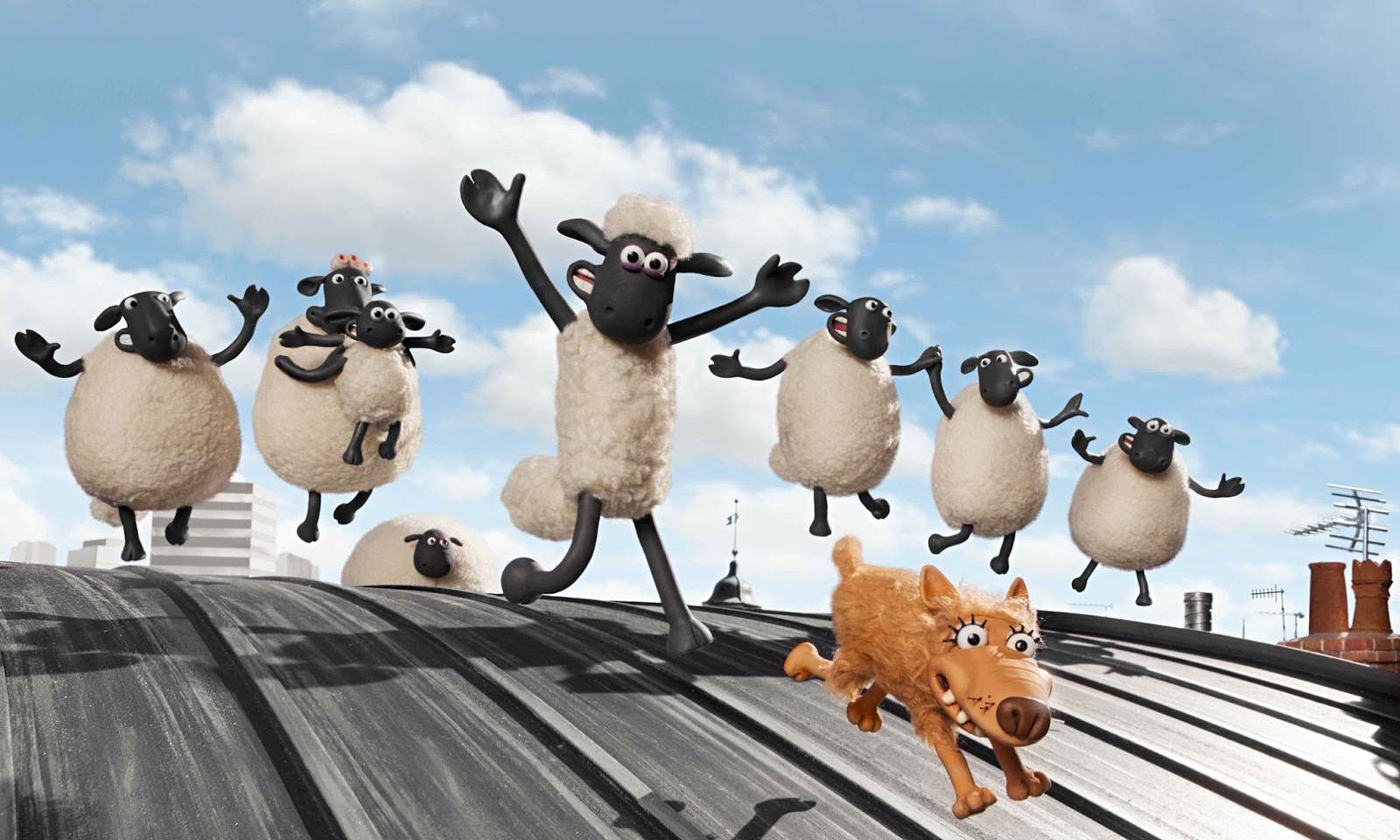
Shaun the Sheep Movie (directed by Mark Burton and Richard Starzak) – The only film in this lineup for the most part strictly for children, Shaun the Sheep Movie is one of my favorite discoveries of the year. I was unfamiliar with the television show on which the film is based, a Wallace & Gromit spinoff also produced by Aardman Animations; however, the Aardman style is unmistakable. Both in its look and its emotional core, Shaun the Sheep Movie is an absolute delight from start to finish.

The stop-motion animation is simply flawless, and the script hits on a number of interesting ideas about routine, taking our loved ones for granted, and the importance of home and family. It is fairly deep stuff for a movie about an intrepid sheep who leads his flock into the big city to find their farmer who has accidentally become an icon of the hairstyling world. The gags are great, the music is wonderful, and if you can allow yourself to be taken in by its charms, Shaun the Sheep Movie is a joyously realized, surprisingly tender little movie.

Boy & the World (directed by AlĂȘ Abreu) – This is the kind of film for which animators tend to fall head over heels. It takes the simple premise of a young boy setting off to find his father who has left home and turns it into an examination of corporatization, globalization, and the way the innocence of youth gives way to the compromise and corruption of adulthood. It blends hand-drawn animation – Abreu made every one of this film’s drawings himself – live-action documentary footage, and a raucous, rousing musical score to create a sensory experience unlike any other.

The film opens with simple line drawings over a white background, depicting a boy who has never left the safety of his home. The more he explores, the more complex the animation becomes, reflecting his fuller understanding of the world around him. It is not a happy life he finds in the larger world. In fact, it is damn hard – demoralizing and dehumanizing in equal measure. He comes to understand how people must find small joys in moments or actions that may seem meaningless but carry great emotional and symbolic weight for them.

When Marnie Was There (directed by Hiromasa Yonebayashi) – The Studio Ghibli banner has always been a mark of quality. From the earliest films of Hayao Miyazaki and Isao Takahata, Ghibli has stood for superbly rendered animation that brings to life worlds of magical realism that help people understand their own inner worlds and struggles a little better. Yonebayashi, who has been an animator of Studio Ghibli films for nearly 20 years, here directs just his second feature, and it is unmatched for majesty and depth of feeling.

When Marnie Was There is the story of a young orphan girl suffering from depression who meets another young girl whose family is always away. Through their friendship, each learns to cope with the pain and difficulties of life. It is rare to see such deep and meaningful female friendships portrayed onscreen, and it is refreshing. To watch Anna and Marnie interact is to watch the work of filmmakers who truly understand what it is to be young, to feel lost and alone, and to discover another soul that looks like yours.

The final analysis


Inside Out is one of the biggest hits of the year, it is culturally ubiquitous, and many would argue it is a new high-water mark for the standard-bearer of animation studios. There is every likelihood more Academy members will have seen Inside Out than the other four nominees combined. Its popularity and its quality will carry it to the win over a remarkable field. Among these nominees, there is no wrong answer, but the winner will be Inside Out.

Will win: Inside Out
Should win: Anomalisa
Should have been here: Minions

Tomorrow: Best Picture