Showing posts with label Jodi Foster. Show all posts

Friday, March 8, 2024

Countdown to the Oscars: Best Supporting Actress


Welcome to this year’s edition of Last Cinema Standing’s Countdown to the Oscars, where we will break down each of the 23 categories, analyze the films, and make some guesses at their awards prospects.


Best Supporting Actress


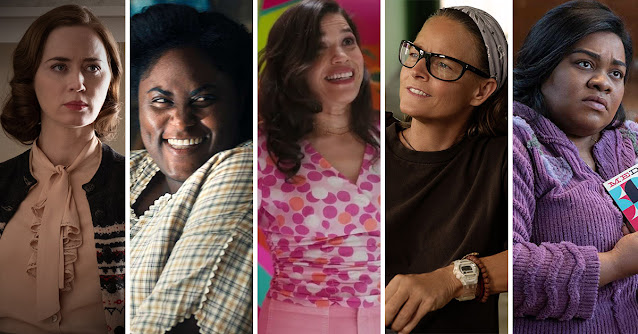
The nominees are:


Emily Blunt in Oppenheimer

Danielle Brooks in The Color Purple

America Ferrara in Barbie

Jodie Foster in Nyad

Da’Vine Joy Randolph in The Holdovers


Emily Blunt in Oppenheimer

Blunt is a very talented actress who has been very good in a lot of things. I am a particular fan of her take on Mary Poppins, and I think she’s pretty pivotal to the success of Looper. So, I don’t begrudge her any accolades or recognition. That said, this is a bad performance and, along with the terrible way Kitty Oppenheimer is written, the worst part of an otherwise fabulous movie. We’ve seen the long-suffering wife of a great man in movies countless times. In a fun twist, this time, she’s a drunk, and Blunt plays the character’s alcoholism in the most paint-by-numbers way possible. It’s like drunk wife bingo.


There’s been a lot of talk about the “great scene” when she turns the tables on the lawyer attempting to railroad her husband in the kangaroo court that forms much of the spine of the movie. I don’t see it. Her victory, if that’s what you want to call it, is pedantic and petty. She calls him out on a point of grammar, which okay, is kind of fun, but there’s no substance there. We’ve been building to this moment, and it just fizzles out.


This is Blunt’s first Academy Award nomination, and as a flashy role in a major Oscar player, it makes sense. With four individual film nominations at the Screen Actors Guild Awards, her peers obviously like and appreciate her work. So, it stands to reason that she’ll make it back to the big show, hopefully for work more befitting her talents next time.


Danielle Brooks in The Color Purple

If you watched Orange Is the New Black back in the early days of Netflix getting into original series, then you were already aware that Brooks has the goods. For everyone else, let The Color Purple serve as your notice. This is a performer we’re going to be talking about for a long time. Brooks brings to the screen her Tony-nominated work as Sofia in this musical adaptation of the Alice Walker novel. Brooks also won a Grammy for the role originated by Oprah Winfrey in the Steven Spielberg film from 1985.


Brooks’ Sofia is full of passion and fire and humanity, and damn can she sing. When she busts out “Hell No!” you just want to stand up and shout along with her. This is a major talent doing starmaking work, and one hopes this nomination leads to more of the kinds of roles she deserves.


America Ferrera in Barbie

From her screen debut in the wonderful Real Women Have Curves to her Emmy-winning work on Ugly Betty to today, Ferrera has been an absolute force in the industry. She has used her platform to lift up fellow Latinx performers, to speak out on national political issues, and to be a voice for women in the industry. She brings all of this intelligence and fearlessness to the role of Gloria in Barbie


When she delivers the big monologue toward the end of the film, we know she comes by these thoughts and feelings honestly, and the film is better for that knowledge. Her speech about the expectations placed on women in modern society has been much praised, discussed, and debated. Only a great speech can stand up to so much scrutiny, and only a great performer can make a great speech work this well.


Jodie Foster in Nyad

It has been 29 years since Foster’s last Academy Award nomination, which came for Nell in 1994. Before that, she had already won two Best Actress statues, for The Silence of the Lambs in 1991 and The Accused in 1988. And, of course, there’s her Supporting Actress nomination for Taxi Driver at the age of 13 in 1976. She’s a brilliant performer and talented multihyphenate who has had one of the most enviable careers in Hollywood.


And, you know what? She’s pretty damn good in Nyad, a movie built solely to showcase the performances of two remarkable actresses (we’ll get to Annette Bening later on in this series). Nyad is a mid-tier inspirational sports drama that falls into a category of something I call “do as I say, not as I do” movies. This is any movie where the main character is presented as an inspirational figure for doing something that is objectively ill-advised. See also: Free Solo and this year’s The Deepest Breath.


Foster plays Bonnie Stoll, the friend who coached Diana Nyad in her attempt to swim from Cuba to Florida – do as I say, not as I do – and their relationship is the heart of the movie. Foster plays Stoll as a strong, intelligent woman who will only take so much of her friend’s crap. It is a necessary counterpoint to the single-minded determination of Bening’s Nyad. There are supporting performances I liked better this year, but it’s hard to be too upset about Foster making it back to the dance.


Da’Vine Joy Randolph in The Holdovers

I have covered some years with juggernauts, just unbeatable performances that immediately announced themselves as that year’s Oscar winner and never looked back. Helen Mirren in The Queen comes to mind as the slam dunk of all slam dunks. Well, to stick with the basketball metaphor, here’s your 2023 Slam Dunk Contest winner.


The second Randolph shows up on screen as Mary in The Holdovers, we understand fully everything we need to know about this woman. Randolph gives her a spark of life and truth. She feels real, so we invest in her story, and Randolph’s performance pays off that investment tenfold. I thought she deserved to be nominated back in 2019 for her lovely performance in Dolemite Is My Name, but sometimes, it’s hard to break through. This performance is the definition of a breakthrough, and it’s about time.


The final analysis


You may have noticed this year I am not digging into the stats and the history as much as I have in past years, particularly with the acting categories. Well, some years, the writing is on the wall, and you don’t need a weatherman to know which way the wind blows. Randolph has won every conceivable award up to this point. There is no runner up. She will have her moment in the sun.


Will win: Da’Vine Joy Randolph in The Holdovers

Should win: Danielle Brooks in The Color Purple

Should have been here: Claire Foy in All of Us Strangers


A note about my favorite snub: One of the absolute best scenes of the year is when the main character in Andrew Haigh’s queer romance comes out to his mother, played by Claire Foy. The mom loves her son, but she is a woman of her time, so she is filled with fear, confusion, concern, and even a little bit of disgust. Foy embodies all of this beautifully, never stepping wrong in a sequence that plays like two performers waltzing through a field of landmines. It could all blow up at any time. That it doesn’t is a testament to Foy, as well as her scene partner, whom we’ll get to soon.

Friday, April 22, 2016

Taxi Driver: Still dangerous, still remarkable 40 years later

Harvey Keitel (left to right), Michael Phillips, Paul Schrader, Cybill Shepherd, Jodie Foster, Robert De Niro, Martin Scorsese, and Kent Jones gathered for a 40th anniversary screening of Taxi Driver at the Tribeca Film Festival. (photo credit: Getty Images)

The day Taxi Driver opened, Feb. 8, 1976, screenwriter Paul Schrader went to a theater across town and saw a line around the corner still as the first showing was to begin. He worried something had gone wrong with the projector or, god forbid, the print. He asked the girl working at the theater what all those people were doing there. She told him they were here for Taxi Driver. He asked if it had not already started, and she said they were lined up for the next showing.

“I walked up [into] the theater,” said Schrader. “It was the very first screening in New York, and the cab pulls out of the steam, and it says ‘Taxi Driver,’ and people in the audience applaud. The film had never been projected before. It was some kind of New York groundswell that just was there.”

To this story, director Martin Scorsese responded: “Incredible. I had no idea. None.”

The scene outside the Beacon Theatre
So went the 40th anniversary screening of Taxi Driver at the Beacon Theatre on the Upper-West Side of Manhattan. Robert De Niro pulled together a reunion of the filmmakers behind the cinematic classic as one of the centerpieces of this year’s Tribeca Film Festival, which he co-founded. Onstage were Scorsese, De Niro, Schrader, Jodie Foster, Cybill Shepherd, Harvey Keitel, producer Michael Phillips, and moderator Kent Jones, who is program director of the New York Film Festival.

The overwhelming feeling of the moment was awe – from an audience with a group of legendary actors and filmmakers assembled before them and from those onstage who still seemed stunned their little film found any success at all.

“What I saw [in the script], I can’t articulate,” said Scorsese. “It just had to be done, that’s all. I think Bob and I, we never really spoke about meaning or theory of any kind. Paul is the one who expresses it. I just had a kind of determination to make it, and I said earlier, I didn’t think it was a film that anybody was going to see. I felt it was just made out of the passion of the situation.”

That passion drips down the screen. It explodes out of the speakers. It demands your attention even when the only thing on screen is an empty hallway, one of the film’s many signature shots. On the big screen, the steam seems to pour out into the theater, and characters that have become larger than life through pop culture and critical appreciation feel more real but still larger than life. This is how this film was meant to be seen – in a packed house with that gorgeous yet ominous Bernard Herrmann score booming throughout the auditorium.

“It’s part of being in the city at night in the summer,” said Scorsese. “You can feel it in the film, Michael Chapman’s photography. You can get a sense of – you can taste – you can taste the humidity, and you can taste the sense of sometimes a kind of anger and violence that was emanating from the streets themselves. It was crazy.”

The city is nothing like that anymore. One imagines that is for the best. The world Taxi Driver depicts feels divorced from reality, like a metaphor for something darker in the human experiment, and it is those things, too, but to a person, the filmmakers assured us life in the city was like that and that people like Travis Bickle and worse were all around.

“When I read it, I identified with it, as I think we all did,” said De Niro. “Even though Marty’s from the heart of New York, I’m from the heart of New York, not far from each other in Manhattan, we just identified with the character.”

Ultimately, the character is the film, as is De Niro’s remarkable, terrifying performance. Pop culture, in some ways, has reduced Travis to a Mohawk and “Are you talkin’ to me?” However, when you see the performance again, in its proper context, it is hard to imagine a more thorough examination of psychosis, of a man on the brink of madness, capable of committing any number of terrible acts, and just waiting for the moment to strike.

“This script began in the best possible way,” said Schrader. “It began as a kind of self-therapy. There was a person who I was afraid of, who I was afraid of becoming, and that person was the taxi driver, and I felt like if I wrote about him, I could distance him from me, and it worked. … After 40 years, that therapeutic power is still imbued in the film.”

A film written as therapy, made out of necessity, depicting a hellscape at the heart of the American soul, one understands the filmmakers’ bafflement at its success. When it debuted at the Cannes Film Festival, Scorsese got wind the jury president, Tennessee Williams, was not a fan. Believing they had no chance to win, Scorsese and the cast did their required interviews and promotions, got on a plane, and came back home.

Phillips stayed behind to represent the film just in case. Well, just in case arrived and the film was announced as the winner of the Palme d’Or, the highest award of the festival and one of the highest honors in all filmmaking. To his shock, Phillips said, when he went onstage to accept the award, half the audience celebrated. The other half booed. After Phillips told the story, Scorsese just shook his head.

Jones, attempting to save the evening from that somewhat downer ending, offered: “Well, the film got the last laugh.”

With that, the assembled legends stood, clasped hands, and took a bow. Forty years and an ocean away from that divided audience in Cannes, hundreds of film lovers had gathered to show their appreciation for a work of pure genius. As the wild cheers of a grateful crowd echoed through the room, the truth was plain for anyone to see. Yeah, the film got the last laugh.

Tuesday, April 19, 2016

Last Cinema Standing presents: Taxi Driver Week

Robert De Niro is Travis Bickle in Martin Scorsese's Taxi Driver.

Martin Scorsese’s Taxi Driver was released Feb. 8, 1976. Three month later, Scorsese won the Palme d’Or at the Cannes Film Festival. Less than a year after that, it was nominated for four Academy Awards, including Best Picture and Best Actor. Now, 40 years on, its place as one of the greatest films ever made is set in stone. It is an unimpeachable classic that still has the power to shock, disturb, and provoke.

To commemorate this landmark achievement and in anticipation of a special 40th anniversary screening at the Tribeca Film Festival, Last Cinema Standing is devoting this week to Taxi Driver. We will have a number of features and reflections over the next several days, all culminating in our coverage of the anniversary screening, where Scorsese, stars Robert De Niro, Jodi Foster, and Cybill Shepherd, and screenwriter Paul Schrader will gather to discuss the film.

This will be an opportunity to look back through the modern history of cinema, of which Taxi Driver is an integral part. We will analyze the film’s legacy and lasting influence, the controversy surrounding its depictions of violence and insanity, and the ways it has seeped into our cultural consciousness. My hope is we will have a lot of fun along the way, too.

Taxi Driver is among my favorite films of all time – there were several years where I would have put it right at the top of the list – and I could not be more excited to see the cast and filmmakers present it on the big screen. If I can translate even a fraction of the joy I take in discussing and viewing this film into the words I write in this space, it will be worth it. So please, join me here over the next few days as we dive into one of the undisputed treasures of cinema.