Showing posts with label Best Supporting Actress. Show all posts

Friday, March 8, 2024

Countdown to the Oscars: Best Supporting Actress


Welcome to this year’s edition of Last Cinema Standing’s Countdown to the Oscars, where we will break down each of the 23 categories, analyze the films, and make some guesses at their awards prospects.


Best Supporting Actress


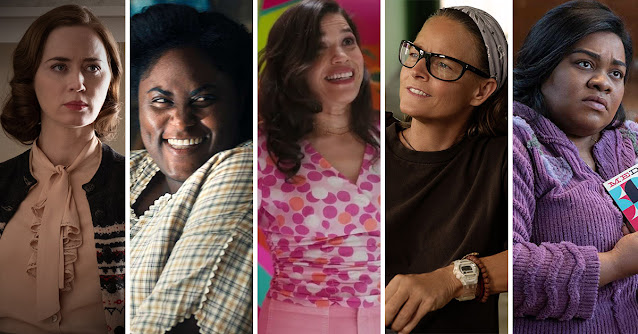
The nominees are:


Emily Blunt in Oppenheimer

Danielle Brooks in The Color Purple

America Ferrara in Barbie

Jodie Foster in Nyad

Da’Vine Joy Randolph in The Holdovers


Emily Blunt in Oppenheimer

Blunt is a very talented actress who has been very good in a lot of things. I am a particular fan of her take on Mary Poppins, and I think she’s pretty pivotal to the success of Looper. So, I don’t begrudge her any accolades or recognition. That said, this is a bad performance and, along with the terrible way Kitty Oppenheimer is written, the worst part of an otherwise fabulous movie. We’ve seen the long-suffering wife of a great man in movies countless times. In a fun twist, this time, she’s a drunk, and Blunt plays the character’s alcoholism in the most paint-by-numbers way possible. It’s like drunk wife bingo.


There’s been a lot of talk about the “great scene” when she turns the tables on the lawyer attempting to railroad her husband in the kangaroo court that forms much of the spine of the movie. I don’t see it. Her victory, if that’s what you want to call it, is pedantic and petty. She calls him out on a point of grammar, which okay, is kind of fun, but there’s no substance there. We’ve been building to this moment, and it just fizzles out.


This is Blunt’s first Academy Award nomination, and as a flashy role in a major Oscar player, it makes sense. With four individual film nominations at the Screen Actors Guild Awards, her peers obviously like and appreciate her work. So, it stands to reason that she’ll make it back to the big show, hopefully for work more befitting her talents next time.


Danielle Brooks in The Color Purple

If you watched Orange Is the New Black back in the early days of Netflix getting into original series, then you were already aware that Brooks has the goods. For everyone else, let The Color Purple serve as your notice. This is a performer we’re going to be talking about for a long time. Brooks brings to the screen her Tony-nominated work as Sofia in this musical adaptation of the Alice Walker novel. Brooks also won a Grammy for the role originated by Oprah Winfrey in the Steven Spielberg film from 1985.


Brooks’ Sofia is full of passion and fire and humanity, and damn can she sing. When she busts out “Hell No!” you just want to stand up and shout along with her. This is a major talent doing starmaking work, and one hopes this nomination leads to more of the kinds of roles she deserves.


America Ferrera in Barbie

From her screen debut in the wonderful Real Women Have Curves to her Emmy-winning work on Ugly Betty to today, Ferrera has been an absolute force in the industry. She has used her platform to lift up fellow Latinx performers, to speak out on national political issues, and to be a voice for women in the industry. She brings all of this intelligence and fearlessness to the role of Gloria in Barbie


When she delivers the big monologue toward the end of the film, we know she comes by these thoughts and feelings honestly, and the film is better for that knowledge. Her speech about the expectations placed on women in modern society has been much praised, discussed, and debated. Only a great speech can stand up to so much scrutiny, and only a great performer can make a great speech work this well.


Jodie Foster in Nyad

It has been 29 years since Foster’s last Academy Award nomination, which came for Nell in 1994. Before that, she had already won two Best Actress statues, for The Silence of the Lambs in 1991 and The Accused in 1988. And, of course, there’s her Supporting Actress nomination for Taxi Driver at the age of 13 in 1976. She’s a brilliant performer and talented multihyphenate who has had one of the most enviable careers in Hollywood.


And, you know what? She’s pretty damn good in Nyad, a movie built solely to showcase the performances of two remarkable actresses (we’ll get to Annette Bening later on in this series). Nyad is a mid-tier inspirational sports drama that falls into a category of something I call “do as I say, not as I do” movies. This is any movie where the main character is presented as an inspirational figure for doing something that is objectively ill-advised. See also: Free Solo and this year’s The Deepest Breath.


Foster plays Bonnie Stoll, the friend who coached Diana Nyad in her attempt to swim from Cuba to Florida – do as I say, not as I do – and their relationship is the heart of the movie. Foster plays Stoll as a strong, intelligent woman who will only take so much of her friend’s crap. It is a necessary counterpoint to the single-minded determination of Bening’s Nyad. There are supporting performances I liked better this year, but it’s hard to be too upset about Foster making it back to the dance.


Da’Vine Joy Randolph in The Holdovers

I have covered some years with juggernauts, just unbeatable performances that immediately announced themselves as that year’s Oscar winner and never looked back. Helen Mirren in The Queen comes to mind as the slam dunk of all slam dunks. Well, to stick with the basketball metaphor, here’s your 2023 Slam Dunk Contest winner.


The second Randolph shows up on screen as Mary in The Holdovers, we understand fully everything we need to know about this woman. Randolph gives her a spark of life and truth. She feels real, so we invest in her story, and Randolph’s performance pays off that investment tenfold. I thought she deserved to be nominated back in 2019 for her lovely performance in Dolemite Is My Name, but sometimes, it’s hard to break through. This performance is the definition of a breakthrough, and it’s about time.


The final analysis


You may have noticed this year I am not digging into the stats and the history as much as I have in past years, particularly with the acting categories. Well, some years, the writing is on the wall, and you don’t need a weatherman to know which way the wind blows. Randolph has won every conceivable award up to this point. There is no runner up. She will have her moment in the sun.


Will win: Da’Vine Joy Randolph in The Holdovers

Should win: Danielle Brooks in The Color Purple

Should have been here: Claire Foy in All of Us Strangers


A note about my favorite snub: One of the absolute best scenes of the year is when the main character in Andrew Haigh’s queer romance comes out to his mother, played by Claire Foy. The mom loves her son, but she is a woman of her time, so she is filled with fear, confusion, concern, and even a little bit of disgust. Foy embodies all of this beautifully, never stepping wrong in a sequence that plays like two performers waltzing through a field of landmines. It could all blow up at any time. That it doesn’t is a testament to Foy, as well as her scene partner, whom we’ll get to soon.

Thursday, March 9, 2023

Countdown to the Oscars: Best Supporting Actress


We’re counting down the days until the Academy Awards! We’ll be here, breaking down each of the 23 categories, talking a bit of history, and trying to figure out who is going to win all those gold statues. So check back throughout the next three weeks for Last Cinema Standing’s Countdown to the Oscars.


Best Supporting Actress


The nominees are:


Angela Bassett in Black Panther: Wakanda Forever

Hong Chau in The Whale

Kerry Condon in The Banshees of Inisherin

Jamie Lee Curtis in Everything Everywhere All at Once

Stephanie Hsu in Everything Everywhere All at Once


This is a mess this year – a big, beautiful, glorious mess. As someone trying to make predictions with at least a little authority, I hate it. As a fan of drama and surprises at the Academy Awards, I love it. I’d normally save this next bit for the final analysis section down below, but it’s just too juicy to wait. Here’s where we stand right now:


For a long time, Angela Bassett was the presumed frontrunner, splitting a lot of the critical accolades with Kerry Condon. But, Bassett is a legend, and there has been a feeling that this is her time. Then, she won the Golden Globe and everything seemed on track. However, Condon came along and won the BAFTA, which as you may know, is my favorite predictor of upsets in the acting categories. So, I was ready to go that way. 


But, the Screen Actors Guild Awards arrived and threw another curveball. Jamie Lee Curtis won. Like Bassett, Curtis is Hollywood royalty and has been doing this thing forever. It wouldn’t be beneath the SAG membership to give an award for a lifetime of achievements, but if that were the case, why Curtis and not Bassett? For what it’s worth, Stephanie Hsu just won the breakthrough performer award at the Independent Spirits, so she’s not out of it either.


The wild card in all of this is that Everything Everywhere All at Once peaked at exactly the right time. It won an unprecedented four SAG awards right as ballots were about to be sent out. It got the WGA and dominated the Indie Spirits with ballots in hand. It looks like a big, historic winner, and nobody doesn’t want to be on the side of that. The problem is: Will Hsu and Curtis split votes? I don’t know. Nobody knows, and it’s great.


Jamie Lee Curtis in Everything Everywhere All at Once – I like Curtis a lot. She was a major part of my childhood in movies like Halloween, My Girl, and House Arrest. She’s wonderful in Prom Night, Knives Out, and the Freaky Friday remake. She seems like a fun, funny presence in interviews and when giving speeches. All around, an easy person to root for. I don’t think she’s particularly good in this movie.


Now, she is saddled with playing a humorless IRS agent, a kind of cult enforcer, and the hot dog-fingered lover of Michelle Yeoh in one universe. It’s all pretty thankless. That said, she’s also overdoing it in every single one of those characters. One could say she is matching the tone of the film around her, and that would be correct, but it doesn’t make it good.


Kerry Condon in The Banshees of Inisherin – Sandwiched between Colin Farrell and Cate Blanchett at the top of my list of the performances of the year would be Kerry Condon as Siobhán. Condon is working in every part of the emotional spectrum, bringing dignity, grace, and common sense to the character who serves as the rational center of this wild story. Such characters can often be drag to play, but Condon’s wit and intelligence make Siobhán just as fascinating as the characters that orbit around her.


It’s not just in the big, showy moments we all saw in the trailer, although she nails those, too. Condon wows in the quiet, sad moments that might otherwise fly by under the radar but which add up to a whole character. The first time she heads down to the pub, intent on grabbing a sherry and being a part of the community, there is a spring in her step and a shy smile on her face. The way she turns down Dominick (Barry Keoghan) for a date is so gentle and honest. There are a dozen little moments like these throughout the film, and they never stop impressing each time they crop up.


Angela Bassett in Black Panther: Wakanda Forever – Bassett knows how to command a room. Ryan Coogler is a magnificent director who knows how to give Bassett the space to shine, but that doesn’t work if Bassett ever gives less than her all, if she ever takes her foot off the gas once. Queen Ramonda must command the respect of every single person in the room at all times, and Bassett accomplishes this through sheer force of will.


A lot has been made of Bassett being the first acting nominee from the Marvel Cinematic Universe. I would argue it’s more remarkable that this recognition is coming for a performer playing a hero. Villains always tend to stand out in comic book movies. They get to have more fun. They’re bigger, bolder. That is why both Heath Ledger and Joaquin Phoenix won Oscars for playing the Joker and no one has ever been nominated for playing Batman. Heroes tend to be too one-note in comic book movies. They are stoic, determined, and representative of a moral certitude that may work in battling evil but doesn’t offer an actor much in the way of range. Bassett cuts through all of that to find depth and layers in a monarch beset on all sides by enemies and standing up to protect her family and her kingdom.


Stephanie Hsu in Everything Everywhere All at Once – Speaking of villains that get to go big, Hsu swings for the fences as this film’s central antagonist, Jobu Tupaki. In a different universe, we are meant to have sympathy for her as Joy Wang, daughter of a chilly, withholding mother. Hsu seems to have a perfect read on both characters, and for all the dumb things the movie makes her do, we at least believe in the characters underneath it all.


You might know Hsu from The Marvelous Mrs. Maisel on Amazon or from Marvel’s Shang-Chi and the Legend of the Ten Rings, but this performance was really the first time I took notice of her. Her strength, spirit, and intensity all jump off the screen, and I can’t wait to see what she does next.


Hong Chau in The Whale – I have not had a chance to see the Kelly Reichardt film Showing Up that premiered at the Cannes Film Festival last May. If, however, it is as good as I have heard, then Chau truly had one of the great years in recent memory. In addition to having Showing Up at Cannes, she had a major role in box-office hit The Menu and garnered this Oscar nomination for The Whale. And though The Whale has not been particularly loved by critics, Chau has received nothing but plaudits for her work.


She plays Liz, a kind of nurse/caretaker to Brendan Fraser’s morbidly obese Charlie. She is protective of him but never coddles him, always urging him to get to a hospital and get his life together. As the film goes on, we learn the depth of their connection, and Liz’s actions take on more meaning and nuance. Chau plays all of this beautifully, matching Fraser’s energy in scene after scene. When she breaks down, Chau makes us feel the wait of her burden and all the pain it is causing her.


The final analysis


Okay, so what are we doing? Let’s look at the recent history of each of the major awards bodies and see which is most vulnerable and which seems right on the money. We’ll use 2010 as a cutoff:


Golden Globes – They have matched with the Oscars nine of the past 12 years. The three they missed were 2020 when Youn Yuh-jung won the Oscar but was not even nominated at the Globes (Jodie Foster won for The Mauritanian in an all-time strange victory); 2015 when Alicia Vikander won the Oscar for The Danish Girl (the Globes went with Kate Winslet in Steve Jobs, who beat Vikander who was nominated for Ex Machina); and the historically close 2013 race when Jennifer Lawrence won the Globe but Lupita Nyong’o memorably won the Oscar.


Screen Actors Guild – The guild has matched the Oscars 11 of the past 12 years. The only miss came in 2018 when the Oscar went to Regina King, who was not nominated at the SAG Awards. The guild went with Emily Blunt for The Quiet Place, a performance that was not even nominated at the Academy Awards.


BAFTAs – The Brits are spottier. They have matched eight times in 12 years. They missed in 2010, going with Helena Bonham Carter for The King’s Speech (eventual Oscar winner Melissa Leo was not nominated). They missed that 2013 race, also going with Lawrence over Nyong’o. They matched the Globes in 2015, going with Winslet over Vikander, who was again nominated for Ex Machina, not The Danish Girl. And, in 2018, like at the SAG Awards, King was not nominated, clearing the way for Rachel Weisz in The Favorite.


Going back to the beginning of the SAG Awards in 1994, only once has a performer won the Oscar without winning at least one of these major awards first (that was Marcia Gay Harden for Pollock in 2000, a performance not even nominated anywhere but the Oscars). So, we can safely eliminate Hong Chau and Stephanie Hsu, though if Hsu wins on the wave of Everything Everywhere All at Once momentum, we shouldn’t be surprised.


The Golden Globes are a weirdo organization, grasping at straws to regain their relevance, and as great as Angela Bassett is, I think she’s running in third place. There may also be an element of MCU bias here, as well. It would be tough to imagine voters getting over that, though they’ve never minded rewarding actors playing the Joker in Batman movies.


So, Curtis or Condon? Well, over more than a decade, the SAG Awards have been the more accurate predictor in this category compared to the BAFTAs, so I’m forced to predict Jamie Lee Curtis. I’m at peace with that. If she wins, I will be right. If she loses to Condon, I will be happy to be wrong. If anything else happens, well, I was never going to get it anyway. That’s it. Curtis. Final answer.


Will win: Jamie Lee Curtis in Everything Everywhere All at Once

Should win: Kerry Condon in The Banshees of Inisherin

Should have been here: Claire Foy in Women Talking


A note about my favorite snub: I mentioned this in my Adapted Screenplay piece, but Women Talking should have been up for a lot more Oscars than the two for which it is nominated. That it received no acting nominations for an ensemble that could easily have made up the entirety of this category will forever baffle me. I could have gone with anyone from the cast in this spot, and Jessie Buckley in particular was brilliant, but if I have to pick one, it’s Claire Foy. Her speech about protecting her children is one of the great movie moments of the year and will stay with me long after this Oscars season has passed.


Next time: Best International Feature

Tuesday, February 14, 2017

Countdown to the Oscars: Best Supporting Actress

Viola Davis is nominated for Best Supporting Actress for her work in Fences.

Welcome to Last Cinema Standing’s Countdown to the Oscars, our daily look at this year’s Academy Awards race. Be sure to check back every day leading up to the ceremony for analysis of each of the Academy’s 24 categories and more.

Best Supporting Actress


The nominees are:

Viola Davis for Fences
Naomie Harris for Moonlight
Nicole Kidman for Lion
Octavia Spencer for Hidden Figures
Michelle Williams for Manchester by the Sea

I promised yesterday I would rail against the obvious category fraud taking place here, so here it goes: Anyone who thinks Rose Maxson (Davis) is a supporting character in Fences is objectively, demonstrably wrong. Not only that, but to consider Rose a “supporting” character is to miss the entire point of her character and in many ways the point of August Wilson’s play, one of its many points, anyway. She is the heart, soul, and center of the story. The version of Fences in which Rose is a “supporting” character is not a version I wish to see.

So how does this narrative form, that Rose is a supporting character and Davis’ a supporting performance? It starts with the studio and its awards campaigners, who believe Davis’ best chance for winning an Oscar is in the Supporting Actress category. In truth, yes, the day it was announced Davis would be campaigned in Supporting Actress, the competition ended. Everyone else was playing for second place. But I cannot believe the critics fell in line with this absurd ruse, that the actors, who honored Davis at the Screen Actors Guild Awards, could not break her out of this box. It boggles the mind.

Now, I will stand up and cheer loudly and vigorously when Davis’ name is called out and she collects the Oscar statue she so richly deserves. Imagine, though, what it would have meant for the world to see the Academy, for just the second time in its 89-year history, to award a black actress Best Actress. It would have been one of the greatest moments in the history of the Academy Awards. Her victory, which is all but assured, will be sweet, but think how much sweeter it could have and should have been.

Viola Davis for Fences – In naming Davis’ work here the best performance by an actress in 2016, I called her a national treasure. This is no exaggeration. When given the kind of material she deserves, the kind that requires depth and honesty and truth and beauty and all of that, Davis delivers every time a performance of depth and honesty and truth and beauty and all of that. Rose Maxson is the role of a lifetime, and Davis, who won the Tony Award for this role when it played on Broadway – in lead actress for those keeping score at home – does not let it pass her by.

Davis is a three-time Oscar nominee, the first time in Supporting Actress for an actual supporting role in Doubt in 2008 and the second time for Best Actress for The Help in 2011. She was the prohibitive frontrunner for The Help but lost to Meryl Streep, who is of course Meryl Streep, so what can you do but tip your cap. There will be no such shock this year. Davis will win. She will receive a standing ovation. And it may just be the best moment of the night.

Naomie Harris for Moonlight – It may seem I am disrespecting the other performances nominated here by suggesting everyone else is playing for second. It is not meant as disrespect but as a show of my overwhelming respect for Davis. The other work cited here is all phenomenal, and Harris in particular delivers a performance of great range and complexity as a drug-addicted mother whose own son seems unknowable to her.

Harris famously had reservations about playing the crack-addicted mother Paula in Moonlight, fearing the trap of playing into obvious stereotypes and caricatures. She was convinced by writer-director Barry Jenkins’ investment in the character and by Paula’s complete emotional arc throughout the film.

The glory of Moonlight is that none of the characters is just one thing, and Harris takes this mission statement as an invitation to explore the rich nature of Paula’s past, present, and future. She strikes a deep vein of emotional truth, eliciting empathy even in Paula’s darkest moments. Were Davis properly cited in the lead category, Harris would be a good bet for the win here and a deserving winner without doubt. As it is, the nomination is likely the reward.

Nicole Kidman for Lion – Kidman may have one of the most difficult careers to pin down of any Hollywood leading lady. The perception of Kidman is that she is an A-list celebrity and movie star of the highest order. She already has won a Best Actress Oscar, for The Hours in 2002, and she has appeared in blockbuster-type films like Batman Forever and The Golden Compass, the relative success and quality of those films not being the point here. To dig deep into her list of credits, however, is to dig into the career of one of the most fearless, experimental, and versatile actresses of our time.

In Lion, she plays Sue Brierly, the adoptive mother of the Indian orphan at the center of the story. Her joy is palpable in offering a second chance at life to a lost child, as is her anguish when she feels that child growing up and slipping away from her. The role of adoptive mother is a thankless one in some ways because no matter your connection, the child has an instinct to know his real mother. This is particularly true in Sue’s case, since her son’s real mother is out there looking for him and never meant to lose him. Kidman plays this inner conflict to perfection, and through her, the audience understands the emotional stakes of the film.

Octavia Spencer for Hidden Figures – In some way or another, each of the women nominated in this category plays a character suffering through the pain of circumstance. There is a wife whose husband gets another woman pregnant, a single mother living in the slums, an adoptive mother losing her grip on her family, and a young mother who suffers a terrible tragedy. Finally, there is Dorothy Vaughan, played by Spencer, whose circumstances may be the most unfair of all. A brilliant mathematician, it is her unfortunate luck to be born a black woman into a segregated world.

What makes Hidden Figures and the women whose story the film tells so inspiring is that they do not allow their obstacles to define them. They define themselves by the ways in which they overcome those obstacles. Vaughan is the supervisor of the black women’s computer unit at NASA, but she is neither treated like a supervisor nor paid like one. Rather than be defeated or retreat into anger, she goes about making herself and her team indispensable, demanding to be noticed for her work simply by doing her work. Spencer, an Oscar winner in this category for The Help, is a joy to watch, playing Vaughan’s moment of triumph as a well-earned relief. Finally, she says, and we all agree.

Michelle Williams for Manchester by the Sea – Williams’ screen time as Randi in Manchester by the Sea is brief, limited to just a couple scenes, but her impact is tremendous. In a film built largely around emotionally devastating moments, Randi’s short, awkward, painful reunion with her ex-husband (Casey Affleck) may take the cake for most heartrending.

Randi is a woman whose new life is built on the ashes of unimaginable tragedy, and Williams shows us how she is always a word, a glance, a moment from everything crumbling into dust again. Watching her try to hold it together in the face of this knowledge is a marvel, and Williams is expert in conveying her fragile foundation. Affleck’s character demonstrates what happens when we bury grief too deeply, allowing it to become a part of who we are. Williams’ Randi is the other side of that coin, what happens when the grief is always right there, just under the surface.

The final analysis


Two words: Viola Davis. Four, if you prefer: Viola Davis, Oscar winner.

Will win: Viola Davis for Fences
Should win: Viola Davis for Fences
Should have been here: Judy Davis for The Dressmaker

Tomorrow: Best Foreign Language Film

Wednesday, February 17, 2016

Countdown to the Oscars: Best Supporting Actress

Alicia Vikander is the frontrunner for Best Supporting Actress at the Oscars for her performance in The Danish Girl.

Welcome to Last Cinema Standing’s Countdown to the Oscars, our daily look at this year’s Academy Awards race. Be sure to check back every day this month for analysis of each of the Academy’s 24 categories.

Best Supporting Actress


The nominees are:

Jennifer Jason Leigh for The Hateful Eight
Rooney Mara for Carol
Rachel McAdams for Spotlight
Alicia Vikander for The Danish Girl
Kate Winslet for Steve Jobs

We can quibble all day over the meaning of “supporting actress” – or more specifically, as this award is officially known, Best Actress in a Supporting Role. I have written a few times throughout this season that while category fraud is common, this year, it has felt rampant, resulting in nominations in this category for two actresses who are unequivocally co-leads in their films.

Anyone who has seen either Carol or The Danish Girl could be forgiven for wondering whom exactly Mara and Vikander are supporting. The same question could be posed, however, for Leigh in The Hateful Eight. The movie is essentially about her, and there is a scarcely a scene in which she does not appear. Each of these actresses has delivered a tremendous performance, but every one of them should have been considered for Best Actress.

Oh, well, no turning back now. It is a campaign strategy that sometimes works and sometimes does not. Marcia Gay Harden (Pollock), Jennifer Connelly (A Beautiful Mind), and Rachel Weisz (The Constant Gardener) all have supporting Oscars for leading roles. However, the first actress we will discuss today can tell you about what happens when the season has its own plans, campaigns be damned.

Kate Winslet for Steve Jobs – Winslet, a seven-time nominee now, earned her only Oscar win for Best Actress in The Reader, this despite master awards campaigner Harvey Weinstein pushing Winslet as a supporting actress. He and many others thought she might have a better chance at the win in the supporting category. There was also some consideration of her clearly leading performance in that year’s Revolutionary Road costing her votes. Ultimately, the Academy nominated her in the proper place for The Reader, and she won because the work was deserving.

This time around, there is no question of category placement. As Joanna Hoffman, Winslet is among the people swirling around the vortex that is Steve Jobs at the center of this film. She is his right-hand woman, his confidant, and his moral center. When he loses his way, she is there to tell him so, and while she cannot always correct his course, she is never afraid to tell him he is wrong.

Most of the other characters in the film are there to be bowled over by Jobs – either awed by his brilliance or cowed by his power. Hoffman is there to stand up to him, and Winslet gives the character a unique blend of inner strength, personal ethics, and business savvy that makes Hoffman memorable and effective. Aaron Sorkin’s screenplay does not always give her the best material, but Winslet takes all that muddled dialogue and creates a real person to whom we can relate and for whom we have sympathy.

Alicia Vikander for The Danish Girl – I said back in April last year when I reviewed Ex Machina that 2015 would be a coming-out party for Vikander. Ten months later, I feel safe in saying I was correct. Apart from stunning work in Ex Machina and her nominated performance in The Danish Girl, she also delivered standout turns in Testament of Youth and The Man from U.N.C.L.E. Next year, we should see her in Justin Chadwick’s Tulip Fever, Derek Cianfrance’s The Light Between Oceans, and Paul Greengrass’ Jason Bourne. It seems she is just getting started.

Holding nothing against Eddie Redmayne’s commendable work, The Danish Girl belongs to Vikander. As Gerda Wegener, the wife of someone going through a major life transition, hers is the experience through which the audience understands the story. We understand her confusion, frustration, and hurt over losing the person she thought of as her husband. As Lili’s transition takes over their lives, Gerda’s life and work is put on hold. In showing this pain and struggle, Vikander shoulders as much of the success of the film as Redmayne but has received much less of the credit. An Oscar win would go some way toward righting that perception.

Rooney Mara for Carol – Make no mistake, Carol is about Therese (Mara) as much as if not more than it is about Carol (Cate Blanchett). There is definitely more politicking involved here than with Vikander’s category misplacement as the film’s awards team likely believed Blanchett and Mara would split votes in the lead category. So, Blanchett – the veteran, a seven-time nominee, and two-time winner – was pushed for lead while the young ingénue, herself a previous nominee for David Fincher’s The Girl with the Dragon Tattoo, was shoved aside in supporting. In any event, the work is highly deserving of any recognition.

Over the course of a love affair, Mara takes Therese from a shy, innocent girl to a confident, world-weary woman. Therese is never more or less than quiet and reserved, but Mara makes us feel the inner turmoil she wrestles with as she experiences thoughts and feelings she never knew were inside her. Early on, the film seems to be about Carol’s influence over Therese, but as the story progresses, we come to realize it is really about what Therese wants out of her life and what she feels about Carol. Mara sells Therese’s dilemma beautifully with stoicism, grace, and tenderness.

Jennifer Jason Leigh for The Hateful Eight – Not one of those three adjectives could be used to describe Leigh’s unhinged performance as Daisy Domergue, but the work sure is something to behold. Leigh plays Domergue like a woman possessed, but behind the bitterness, sarcasm, and yeah, hate, there lies intelligence, cunning, and strength that let the audience know why so many people are concerned with taking this woman to hang. She takes insult after insult, beating after beating, and she still stands up to spit blood and bile back at her captors.

It is an entirely different look for Leigh, who to this day probably remains best known for her early role in Fast Times at Ridgemont High. She has spent her career carving a niche in the independent and art film world, and she has excelled in such films as eXistenZ, Margot at the Wedding, and Synecdoche, NY. Here, she lets loose with the rage and demonic force of someone who cannot help but fight, no matter how dire her circumstances. The Hateful Eight is a film about villains, and she may be the biggest villain of all, which just makes her the most fun to watch.

Rachel McAdams for Spotlight – A bit of a surprise nominee, though not wholly out of thin air, McAdams’ nomination seems like evidence of Spotlight’s overall strength with Academy. She plays journalist Sacha Pfeiffer, who is smart, determined, and empathic in the pursuit of the most difficult story of her career. In keeping with the general theme of Spotlight, her work is not flashy but effective. She knows that no matter what she is going through, the story is not about her. It is about the victims and survivors whose suffering she is trying to bring to light.

McAdams shines most in the one-on-one interviews she conducts with survivors, particularly the first, which takes them from a coffee shop to a walk in the park, past one of the many Catholic Churches that litter Boston’s streets. McAdams is expert at showing how Pfeiffer gets the source to trust her and open up about things he has told almost no one in his life. Her heroism comes from the fact that she is not using this man for her own gains. She genuinely wants to help him and all others in his situation the best way she knows how – with the power of the truth.

The final analysis


At the beginning of the awards season, when it looked as though Vikander and Mara would end up in the supporting category, most pundits had this down to those two with a slight edge to Mara for appearing in the more popular Carol. It was not an unreasonable assumption, and most of that has come to pass, except Vikander has really started to run away with things. It is not exactly cut and dry, though, as Winslet won both the Golden Globe and the BAFTA for her performance, while most of the early season critics’ awards went to Leigh and Vikander but for Ex Machina.

The trouble with predicting Winslet, who would be a good bet based on those two major awards, is that she was not nominated against Vikander’s The Danish Girl performance, which was considered a leading performance by both organizations. The only major place they were nominated against each other was the Screen Actors Guild Awards, which Vikander won. I expect that ultimately to be more predictive of the Oscars and for Vikander to win on the strength of her performance, the fact it is a leading role, and her overall body of work this year.

Will win: Alicia Vikander for The Danish Girl
Should win: Jennifer Jason Leigh for The Hateful Eight
Should have been here: Günes Sensoy for Mustang

Tomorrow: Best Supporting Actor

Tuesday, February 17, 2015

Countdown to the Oscars: Best Supporting Actress


Patricia Arquette is nominated for Best Supporting Actress for her performance in Boyhood.

Each day as we make our way to the Academy Awards ceremony Feb. 22, Last Cinema Standing will take an in-depth look at each of the categories, sorting out the highs, the lows, and everything in between. Check back right here for analysis, predictions, and gripes as we inch toward the Dolby Theater and that world-famous red carpet.

Best Supporting Actress


The nominees are:

Patricia Arquette for Boyhood
Emma Stone for Birdman
Keira Knightley for The Imitation Game
Meryl Streep for Into the Woods
Laura Dern for Wild

Three mothers, a daughter, and a colleague – those are the characters portrayed by the five women nominated for Best Supporting Actress, not exactly a full range of human experiences, but look closer. Among those you have an all-powerful witch, a strong, resilient teacher, and a brilliant mathematician. Now things are starting to look a little better.

With good reason, the topic of quality roles for women comes up constantly in the Oscar season and beyond. Undoubtedly, there are too few female-led films, too few stories told about the great women throughout history – or even the not-so-great women. More roles, however, do not necessarily mean better roles. What we need are more parts for women that are as deep, complex, and emotionally rich as their male counterparts. That will be progress.

Not all of the nominees for Best Supporting Actress this year fit that mold, which is a shame, considering how many great performances were left on the sidelines in favor of these. However, the two roles here that do require depth and soul are two of the best characters of the year and feature two of the best performances. These are all great actresses, and with the right material, each is capable of delivering stunning work, as proven by the two actresses here who were given some of the best material of the year. Hopefully, the best material keeps coming to all of them.

Patricia Arquette for Boyhood – There is a way of reading Boyhood wherein Arquette is the film’s lead, and I do not think anyone would have blinked had she been nominated in the Best Actress category. While the film ostensibly concerns the coming of age of a young Texas boy, Arquette plays the woman who raises that boy while at the same time figuring out the person she wants to be. Most parents who see the film instantly identify with Arquette’s struggle as she bounces around from being a single mother to an abused wife to a single mother again, all while striving to do what is best for her children.

Arquette comes from an acting family, and she has been in the Hollywood game almost 30 years. She spent 12 of those years making Boyhood. The dedication alone is enough to impress, but the awards success she has already seen for the film goes deeper than that. Reflecting back on Boyhood, it is her character and her journey that stand out as pivotal to the film.

Writer-director Richard Linklater and Arquette collaborate to make the character more than a mom. She is a wife, a lover, a student, and a teacher. She is a real person with real regrets and real fears about where her choices in life are taking her and where they have brought her. When she wonders aloud toward the end of the film what dedicating her life to her children has brought her, we cannot shame her for feeling that. We can only empathize with a woman who has given so much in life and received so little.

Emma Stone for Birdman – Sam, as played by Stone, is the voice of her generation, but it is not meant to be a flattering portrayal. As washed-up actor Riggan Thompson’s (Michael Keaton) daughter, Sam is all self-absorption and self-importance. She has an answer for questions she has not yet been asked and opinions on topics about which she knows nothing. She is the social media culture incarnate and a dire warning for where a generation raised on Facebook, Twitter, and YouTube may be headed.

Stone is perfect in the role, bringing the energy and anger of youth with a hint of deeply buried vulnerability. About midway through the film, Stone delivers a monologue so brutal and so cutting that it threatens to take the character beyond the point of redemption, but with the subtlest change in her facial expression, Stone brings us back around, if not to her side, then to the middle. Wordlessly, she expresses regret about her tirade but resolutely refuses to admit she may have been wrong. It is a moment that relies entirely on the actress’ face, and Stone nails it.

Meryl Streep for Into the Woods – You all know Meryl Streep. You know what she has accomplished – three Academy Awards and 19 nominations, more than any other actor in history. She has tried everything and been everybody – a factory worker, a prime minister, a singer, a druggie, an adventurer, and a nun, among countless other roles. She is a legend who could show up to work and earn a nomination for her safe driving, if such an organization existed to hand out awards. Ultimately, that is part of the problem.

Streep is good in the part of the witch. There is no denying it, but the kneejerk reaction to Streep piling on the makeup or putting on an accent is to nominate her for an award. I am saying that should probably stop. If Academy members really think this performance, this year, is one of the five best performances by an actress in a supporting role, they need to see more movies. Royalty is royalty. The prize is being such. We do not need to weigh her down with more accolades just for showing up, donning a wig, and belting out a few songs, however ably. Let’s think outside the box once in a while.

Keira Knightley for The Imitation Game – Not yet 30 years old, Knightley is a two-time nominee who has shown a facility for transitioning from epic blockbusters to period dramas to low-budget indies. In 2014 alone, she appeared in Jack Ryan: Shadow Recruit, The Imitation Game, and Begin Again. She is an immensely talented actresses with many years of strong characters and great performances ahead of her. The Imitation Game, however, will hopefully be just a footnote to her career.

As capable as Knightley is, she is given little to do as Joan Clarke, Alan Turing’s (Benedict Cumberbatch) colleague, wife, and confidante. Though we are briefly shown Clark’s talent for mathematics and code breaking, the film serves as an ode to the greatness of Turing. As such, Clark is written merely as another character to stand in awe of Turing and bear witness to his greatness. Knightley does her best, but she is hamstrung by a part that as written, lacks complexity or emotional depth.

Laura Dern for Wild – Speaking of good actresses with minimal characters to play, Dern makes little more than a couple cameo appearances in Wild, despite being the whole reason for the story. Dern plays Bobbi, Cheryl Strayed’s (Reese Witherspoon) mother. We see her only in flashbacks as Strayed hikes up the Pacific Crest Trail. We learn more about Bobbi from Strayed’s voiceovers and conversations with other people than we do in the precious little screen time Dern actually has.

Some of this is due to the script and some is due to director Jean-Marc Vallée’s impressionistic style, which requires that actors in small roles have a big impact. Vallée has cast the right actress for the task in Dern, but her passivity only serves to undercut any strength Dern would have brought to the part. The character mostly serves as a sounding board for Witherspoon’s more assertive Strayed. None of this is to say Dern’s performance is bad, but awards worthy it is not.

The final analysis


When it comes to the win, there is Arquette and no one else. She has won every conceivable precursor award, including from the Screen Actors Guild, the Golden Globes, and the British Academy of Film and Television. She will win the Oscar in a walk, and it will be as much for her performance in Boyhood as for a lifetime of turning in strong work in film and on television. She is a deserving actress, and I look forward to her acceptance speech.

Will win: Patricia Arquette for Boyhood
Should win: Emma Stone for Birdman
Wish she had been here: Katherine Waterston for Inherent Vice